loveMONEY EN-US
The world's oldest stories making billions today
The ancient tales behind the blockbusters
By Daniel Coughlin · August 6, 2026
The ancient tales behind the blockbusters
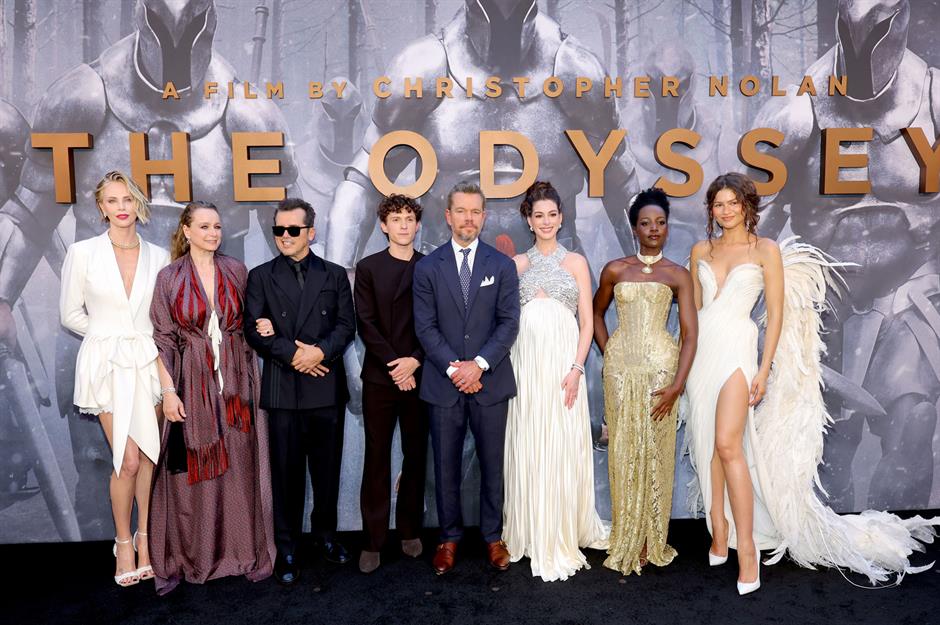
Christopher Nolan's star-studded The Odyssey has introduced a vast new audience to Homer's epic tale of monsters, gods, and one man's journey home. Believed to have been composed in the late eighth to early seventh century BC, the story may be around 2,700 years old, yet it remains potent enough to power what's becoming a billion-dollar juggernaut. And it's far from alone.
Click or scroll on to discover the ancient narratives still generating enormous revenues today, from enduring classics to fairytales whose origins disappear into the mists of time.
All dollar values in US dollars
The Epic of Gilgamesh: over 4,100 years old
First inscribed around 2100 BC in ancient Mesopotamia, The Epic of Gilgamesh is the world's oldest surviving literary work. It follows the eponymous king of Uruk through friendship, grief, and a doomed search for immortality.
Scholars have identified striking parallels with The Odyssey, which may have borrowed from the older epic. Meanwhile, Gilgamesh is a major character in Japan's Fate franchise, whose mobile game Fate/Grand Order has generated billions of dollars.
The Ramayana: around 2,800 years old
Attributed to the sage Valmiki, with its ultimate origins in the eighth century BC, The Ramayana recounts how Prince Rama, aided by Hanuman and an army of monkeys, rescues his abducted wife Sita from the demon king Ravana.
After inspiring countless films, TV series, plays, and comics, the tale is now receiving its grandest treatment yet: a two-part adaptation set for release over Diwali 2026 and 2027, starring Ranbir Kapoor, Sai Pallavi, and Yash. Billed as India's most expensive film project, it boasts a reported budget of up to $500 million.
The Iliad: over 2,750 years old
Usually dated to the mid-eighth to early seventh century BC, Homer's The Iliad came before The Odyssey, though both actually draw on an even older oral tradition. The epic focuses on Achilles' rage during several weeks of the Trojan War's 10th year.
The tale's modern afterlife remains lucrative. Brad Pitt's Troy grossed almost $500 million in 2004, Madeline Miller's 2011 novel The Song of Achilles became a number-one New York Times Best Seller and Emma Thompson is adapting Pat Barker's female-led retelling The Silence of the Girls for cinema. The ancient conflict also continues to fuel novels, stage productions, and video games.
The Odyssey: over 2,700 years old
The ancient Greek epic follows Odysseus on his perilous 10-year journey home after the Trojan War. Its influence has never faded: the Coen brothers reworked it in 2000 as O Brother, Where Art Thou?, while 2024's The Return starred Ralph Fiennes as the battle-scarred king.
Christopher Nolan's $250 million spectacle earned over $700 million in just 12 days and is poised to surpass $1 billion. The movie has also boosted the original poem: US print sales are up 76% this year, with Emily Wilson's translation reaching number two on the nationwide bestseller list.
The Labours of Hercules: around 2,700 years old
The ancient Greek hero Heracles, better known as Hercules, is ordered to complete 12 dangerous tasks. These include killing the Nemean Lion, defeating the many-headed Hydra, and capturing Cerberus, the guard dog of the underworld.
The fixed cycle of 12 is attributed to a now-lost epic by Peisander, written around the seventh century BC.
Hercules is now a screen fixture. Disney's 1997 animated movie grossed $253 million worldwide, while Dwayne Johnson's 2014 adventure added $245 million, with TV series, stage shows, video games, comic books, and merchandise bringing in millions more.
Perseus and Andromeda: around 2,600 years old
One of ancient Greece's most famous adventures tells how Princess Andromeda was chained to a rock as a sacrifice to a sea monster after her mother's boast angered the gods. Perseus, returning after beheading Medusa, rescues and marries her.
The myth inspired 1981's Clash of the Titans. Its 2010 remake grossed $493 million worldwide, while 2012's Wrath of the Titans added $302 million. The story and its characters have also been depicted in TV shows, comic books, and video games.
The Mahabharata: around 2,400 years old
India's other great ancient epic, The Mahabharata took shape over centuries from around 400 BC and is traditionally linked to the sage Vyasa. At roughly 1.8 million words, it's among the longest poems ever written, charting a dynastic struggle between the Pandavas and Kauravas that culminates in the Kurukshetra War.
The tale has formed the basis of generations of screen adaptations, including major TV events in 1988 and 2013. The 2024 sci-fi blockbuster Kalki 2898 AD then transported its characters into the future, grossing $126 million worldwide, with a sequel now in production.
Cinderella: around 2,000 years old
Cinderella's roots stretch back to a tale recorded by Greek geographer Strabo in the first century AD recounting how an eagle steals the sandal of Rhodopis and drops it before an Egyptian king. He searches for the shoe and marries its owner.
The version familiar to us today owes most to Charles Perrault's 1697 Cendrillon, which introduced the fairy godmother, pumpkin coach, and glass slipper.
Disney's 1950 animation turned the tale into a global brand and its 2015 remake grossed $542 million. Amazon offered another musical reinvention starring Camila Cabello in 2021, while stage shows, theme parks, games, and merchandise continue to bring in big bucks.
Beauty and the Beast: around 1,900 years old
Beauty and the Beast's direct ancestor is often identified as Cupid and Psyche, recorded by Roman writer Apuleius in the second century AD. The recognizable fairytale emerged in 18th-century France and, like Cinderella, has been a go-to for Disney over the years.
Its 1991 animation pulled in $439 million worldwide, while the 2017 live-action remake starring Emma Watson and Dan Stevens took $1.26 billion. Together, the movies grossed almost $1.7 billion, with theme parks, video games, merchandise, and other revenue streams adding to the total.
Liking this? Click on the Follow button above for more great stories from loveMONEY
The Legend of King Arthur: around 1,600 years old
The Legend of King Arthur has its origins in the fifth century, though the earliest substantial surviving account appears in the ninth-century Historia Brittonum. Later writers added Camelot, Excalibur, Merlin, Lancelot, and the Holy Grail.
The legend has long been a mainstay of books, games, film, TV, and other media. Recent big-budget adaptations include Guy Ritchie's 2017 King Arthur: Legend of the Sword, which grossed $149 million.
Meanwhile, Japan's multibillion-dollar Fate franchise reimagines the mythical king as the female knight Artoria Pendragon.
The Ballad of Mulan: around 1,500 years old
Composed around the sixth century AD, The Ballad of Mulan tells of a young woman who disguises herself as a man and takes her elderly father's place in the army. The story evolved over the centuries and was already a staple of Chinese film, TV, opera, and comics long before receiving the Disney treatment.
Disney's 1998 animated movie grossed $304 million worldwide and spawned a direct-to-video sequel, while the studio reportedly spent $200 million on its 2020 live-action remake.
The Thousand and One Nights: over 1,001 years old
The earliest surviving fragment of The Thousand and One Nights dates from ninth-century Syria. At its heart, Scheherazade avoids execution by telling her jealous husband King Shahryar a story each night, leaving it unfinished so he spares her to hear the ending. The collection grew over centuries, absorbing tales from the Middle East, Asia, Africa, and possibly even Greece.
One later story attached to it, Aladdin, became its richest modern spin-off. Disney's 1992 animation grossed $504 million and its 2019 remake brought in over $1 billion.
Rapunzel: over 1,000 years old
One of the earliest Rapunzel-like figures appears in Ferdowsi's Persian epic Shahnameh, completed in 1010. Princess Rudabeh lowers her long hair from her palace so her lover Zal can climb up, although he uses a lasso instead. The more familiar maiden-in-the-tower tale later appears in Giambattista Basile's 17th-century Petrosinella and the Brothers Grimm's version.
Disney transformed the story into Tangled. The 2010 movie grossed $592 million worldwide and spawned a short film, as well as a three-season TV series, video game, theme park attraction, and extensive merchandise.
The Ragnarök Myth: around 1,000 years old
The Norse apocalypse Ragnarök has its earliest mention in the Icelandic poem Völuspá, which scholars date to the 10th century. The story foretells a final battle that results in the demise of Odin, Thor, and other gods, before a renewed world emerges.
Fast forward to 2017 and Marvel's Thor: Ragnarok grossed $854 million worldwide, while Sony's God of War Ragnarök video game pulled in a similar number in 2022.
The myth also inspired Dawn of Ragnarök, the largest expansion in Assassin's Creed history, for 2020's Valhalla, a game that has generated over $1 billion. Also in 2020, Netflix brought the prophecy to modern-day Norway in its three-season drama Ragnarok.
The Legend of Amleth: around 800 years old
Recorded by Danish chronicler Saxo Grammaticus around 1200, the story follows Prince Amleth, who feigns madness while plotting revenge against the uncle who murdered his father and married his mother. Around 1600, William Shakespeare transformed The Legend of Amleth into Hamlet, an anagram of the name, spawning a plethora of stage and screen versions.
The tragedy also helped inspire Disney's The Lion King: its 2019 remake raked in $1.66 billion, while the stage musical has collected over $9 billion. Robert Eggers returned to the medieval source for 2022's Viking epic The Northman, which grossed $76 million.
Romance of the Three Kingdoms: around 700 years old
The oldest of the Four Great Classical Novels of Chinese literature, Romance of the Three Kingdoms was written in the 14th century and is traditionally attributed to Luo Guanzhong. Set around 1,000 years earlier, it follows the warfare, alliances, and betrayals that erupt after China's Han dynasty collapses.
The story has become a gaming powerhouse in recent years: Three Kingdoms Tactics had generated $1.2 billion in player spending by early 2021, while Koei Tecmo's Dynasty Warriors and Romance of the Three Kingdoms series have sold over 33 million copies combined.
Sleeping Beauty: around 700 years old
This iconic tale made its debut in the 14th-century French romance Perceforest. Charles Perrault's 1697 retelling and the Brothers Grimm's later Little Briar-Rose helped shape Disney's 1959 animation, which also drew on Tchaikovsky's 1890 ballet.
Disney then recast the villain as the heroine of Maleficent, with Angelina Jolie playing the titular character. The 2014 movie grossed $760 million worldwide, while its 2019 sequel Mistress of Evil racked up an additional $492 million. The story has also inspired operas, various other screen adaptations, video games, and comic books.
The Legend of Robin Hood: around 650 years old
The first dated reference to the tales of Robin Hood appears in William Langland's 1370s poem Piers Plowman. The legend follows the skilled archer and his Merry Men as they defy the Sheriff of Nottingham, with later versions making him famous for robbing the rich to help the poor.
Adapted numerous times for the screen, Kevin Costner's 1991 Robin Hood: Prince of Thieves ranks as the most successful of the lot, having grossed $390 million, almost $1 billion in today's money.
The runner-up is Ridley Scott's 2010 take on the story starring Russell Crowe and Cate Blanchett, which amassed $322 million.
Investiture of the Gods: around 450 years old
Published in the 16th century, Investiture of the Gods blends history and mythology to recount the fall of China's Shang dynasty and the rise of the Zhou. Its gods, demons, and heroes include the rebellious child deity Ne Zha.
The novel has formed the basis of myriad adaptations, including a 65-episode Chinese TV series in 2019. That same year, the animated movie Ne Zha hauled in around $720 million worldwide. Its 2025 sequel did even better, earning $2.27 billion to become the highest-grossing animated movie of all time.
Journey to the West: over 430 years old
Published in its familiar form by Wu Cheng'en in the 1590s, this Chinese classic grew from medieval stories about seventh-century monk Xuanzang's pilgrimage to India. Accompanied by the Monkey King and other supernatural disciples, he battles monsters while seeking Buddhist scriptures.
Another of the Four Great Classical Novels of Chinese literature, the tale has inspired everything from cult Japanese TV series Monkey to the Dragon Ball manga media franchise. Its biggest recent hit, the video game Black Myth: Wukong, has reportedly made over $1 billion.
Liked this? Click on the Follow button above for more great stories from loveMONEY