loveEXPLORING EN-UK
Europe's 31 most amazing subterranean attractions
Underground Europe: attractions that lie beneath
By Dale Maxwell · August 1, 2026
Going deeper underground
Have you ever visited the 'other' Europe? The subterranean part of the continent lurking beneath the cities, mountains and countryside that we already know? There are caves, ancient cities, museums and even theme parks down there, all waiting to be enjoyed and explored.
Click or scroll through this gallery to discover 31 of Europe's underground attractions that our well-travelled team believe are the best.
31. The Adventure Mine Sauna, Dalarna, Sweden
Kicking off our ranking is this disused mine in central Sweden, which has been given a new lease of life. It's now a traditional wooden sauna. The temperature is a consistent 4°C (39°F), so don a helmet with a headlamp, join the guided tours and travel down 262 feet (80m).
You can listen to Nordic mysteries, have a dip in the clear waters and then have a sauna experience like you've never had before. Don't leave without trying the 'lady of the mine' sauna ritual. It will simultaneously take your senses from hot to cold, soft to hard and dark to light. All this with not a social media platform in sight...
30. The Tokaj Wine Region, Tokaj, Hungary
Around two and a half hours from Budapest, scattered among the foothills of the Zemplen mountains, are the villages that make up the Tokaj Wine Region. With a history of wine making going back thousands of years, a visit to the underground cellars scattered throughout these villages are a must.
The cellars and their underground labyrinths were carved out of slabs of volcanic rock, providing the perfect production and storage environment for this variety of wine.
29. Betina Cave Beach, Dubrovnik, Croatia
One of the most beautiful beaches in Europe, this hidden gem is nestled on the picturesque coast of Dubrovnik, Croatia. The crystal-clear waters and white pebbles are straight from local postcards, but it is the nearby Betina Cave that offers the excitement.
This underground network extends up to 164 feet (50m) below the surface and is popular with divers and snorkellers.
Love this? Follow our Facebook page for more travel inspiration
28. Saint-Léonard underground lake, Valais, Switzerland
The largest subterranean lake in Europe, this surprising Swiss water feature is a captivating combination of eerie mystery and soothing serenity. It takes a full half an hour for boats to glide across the 1,000-foot long (300m) and 65-foot wide (20m) lake, hidden up to 230 feet (70m) beneath the Alpine mountainsides above.
Strategically-placed lights splash across the jagged walls, making the dark corners even darker by comparison, while your guide regales you with tales from the cavern's curious past.
27. Zollverein Coal Mine Industrial Complex, Essen, Germany
Another grand mine, Zollverein was once the biggest of its kind across the globe, with 8,000 miners working day and night at its peak. Coal was mined here for 135 years until the mine's closure in 1986. These days, you can take a tour through the old coking plant (Europe's biggest until production ceased in 1993), where you'll see the original machinery as you get taken on conveyor belts and through shafts.
The architecture, with its precision and design, are symbolic of German efficiency, and these days the buildings house exhibitions, museums and festivals. To explore this fascinating World Heritage Site, it's best to allow for a whole day.
26. Under, Lindesnes, Norway
A restaurant with a difference, Under, in Norway, offers the chance to witness the rich diversity of the icy Atlantic – ironically from inside the gastronomic equivalent of a goldfish bowl. As you might expect, this amazing eatery with its unique idea comes with unpredictability.
While the restaurant can't guarantee what swims by as you gaze out into the dark depths, they can pretty much promise fine dining excellence.
25. Blue Grotto, Capri, Italy
A good idea for a romantic excursion, this sapphire gem on the coast of Capri is a hidden beauty. The Blue Grotto wows its visitors with its enchanting surreal blue glow, and gets its name and its appearance from the sunlight that enters the water from outside.
Take a boat ride into the cave, which is about 492 feet (150m) deep, but only when the sea is calm. The best time to visit is in the summer, mainly due to the low water levels. Just make sure you duck to enter through the narrow gap.
24. Devil's Throat Cave, Bulgaria
This ranking had to include one of the best-known caves of all. The river that falls down this ravine has created the tallest underground waterfall in the Balkans at 137 feet (42m) high. You can only enter with a tour guide, who will take you through the hallways into the cave's main feature – the Roaring Hall, a huge chamber etched out by continuously falling water.
Why is it called Devil's Throat? Because the water that falls here disappears. Scientists have carried out experiments but do not know where this water actually goes.
23. Medieval Underground and Dungeon Historical Tour, Prague, Czechia
A lot of tales from yesteryear require going off the beaten path now and again, and this guided tour provides an insight into a hidden world below Prague's streets that most visitors will never see. A short tour will fascinate you with mysteries and dark tales of this capital city's complex past.
Tortures, dungeons, murders, plots; see what shaped medieval Prague into the city it is today.
Liking this? Click the Like button above. And click the Follow button above for more great stories from loveEXPLORING
22. Lamprechtsofen, Austria
This impressive limestone cave was once the deepest known cave in the world. It now stands in fifth place, but is incredibly deep nonetheless at 5,692 feet (1,735m). You can visit the cave on tours and climb down the 392 stairs towards the river, snaking its way through the bottom.
The cave has a history of fatalities and was closed in 1701 to stop treasure seekers. According to local legend, they began plumbing the depths to search for riches believed to have been hidden by a knight.
21. Great Copper Mountain, Falun, Sweden
This copper mine dates back over 1,000 years and was the biggest producer of copper on the planet in the 17th century, accounting for 70% of western copper production. The 'great pit' dominates the landscape and is a one-mile (1.6km) walk around the top.
Descend through the tunnels 219 feet (67m) deep into the mine and hear the fascinating tales and history, while you experience the challenging conditions that miners had to endure.
20. Underground Naples, Italy
Synonymous with Margherita pizza, Vesuvius and Maradona, most of us are at least vaguely aware of what Naples has to offer travellers. However, there is a different side to this cultured Italian city.
Take a journey back in time on a half-day tour to discover a network of caves and tunnels some 131 feet (40m) under the streets. Some of these dark passageways are over 2,400 years old. Visit old air raid shelters from World War II, see a Roman aqueduct, tour a cavern used as a cistern and even visit the ruins of an old theatre.
19. Postojna Cave, Inner Carniola, Slovenia
Accessible all year round, southwestern Slovenia's incredible caverns and tunnels can be explored on foot and even by electric train – the only double-tracked cave train track in the world. Don't miss the spectacular white stalagmite aptly called Brilliant, with running water contributing to its shiny appearance.
As well as marvelling at the rock formations, perhaps the most famous feature of this cave are the 'baby dragons' – cave dwelling olms that could be straight out of a subterranean sci-fi movie. These incredible creatures can go without food for years.
18. The Louvre, Paris, France
Along with the Eiffel Tower, the Louvre has adorned the front covers of French textbooks for years. On the banks of the Seine, this enormous building with the symbolic pyramid at its heart is the largest museum in the world, at over 785,000 square feet (73,000sqm).
The planet's most famous painting is housed here and, as well as the Mona Lisa, there are many galleries and exhibitions (and even secrets) to view at any time during the year.
17. Churchill War Rooms, London, England, UK
These were the underground secret corridors where Winston Churchill sheltered and, along with his aides, masterminded the UK's defences during World War II.
One of London's must-see attractions, the most surreal thing here is that the rooms have largely been left untouched, which helps to imagine what it might have been like during the horrors and tensions of the Blitz.
16. De Ruien, Antwerp, Belgium
Underneath Belgium's largest city lies a remarkable feat of engineering. These canals and tunnels were built in the 14th century to both provide water and to transport goods around the centre of Antwerp. The waterways, over time, were expanded and used also as sewers.
You can take a self-guided tour or join a group. Armed with a tablet and a 'strong will', you can experience a different part of this tiny country. Just try to maybe breathe through your mouth.
15. Thríhnúkagígur volcano, Iceland
Iceland is well known for its volcanoes, most of them active, so getting the chance to go inside a dormant one is an opportunity not to miss if you ever visit these seismic shores. This one, Thríhnúkagígur (meaning 'three peak crater' in English) last erupted over 4,000 years ago.
The enormous magma chamber with all its unique rock formations is the only one accessible on Earth, and gives a slight glimpse of what it might be like down in the bowels of the planet.
14. Catacombs, Paris, France
If you like being spooked out and have morbid curiosity, this could be the underground tomb for you. Welcome to Les Catacombes de Paris – the final resting place for over six million of the city's residents.
Why did this become one of the biggest graveyards in the world? Simply put, the city's burial sites were overflowing. This eerie labyrinth stretches over 174 miles (280km), although only a small section is open to tourists. The remains are artistically stacked, so come and fully learn and appreciate the history of this fascinating place.
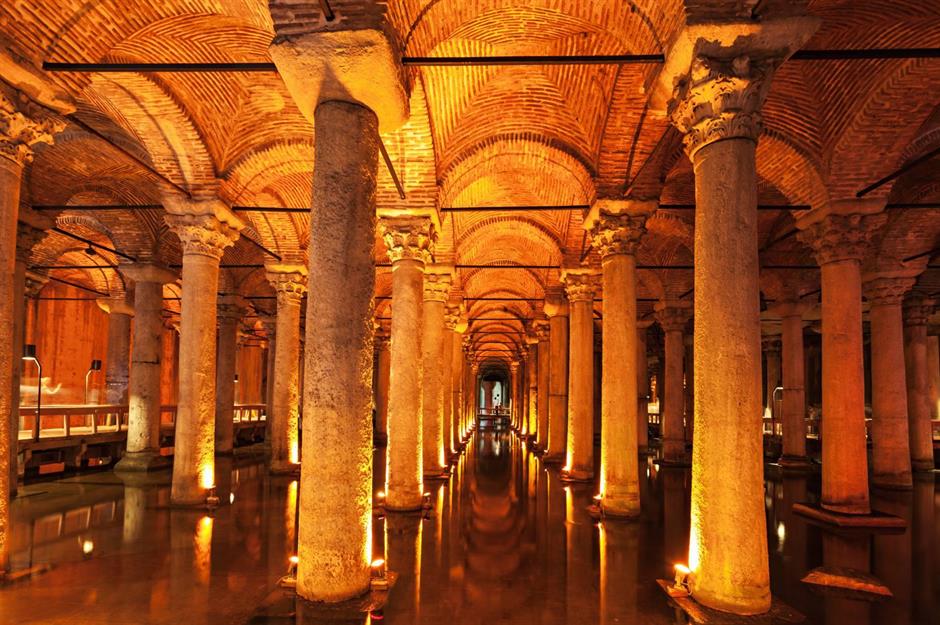
13. The Basilica Cistern, Istanbul, Turkey
One of the most amazing structures situated beneath the city of Istanbul, the Basilica Cistern is 469 feet long (143m) and 213 feet wide (65m). It could hold over 80,000 cubic metres of water coming from the Belgrad Forest, around 12 miles (20km) from the city. The cistern lay undiscovered until the 16th century.
Residents were once able to fish out carp from their basements, and still to this day fish swim in the waters. Tourists can view the site from raised platforms, and the lighting and cooler temperatures also make for a great escape from the scorching Turkish sun.
12. Zip World Llechwedd, Wales, UK
If you want to combine history with a bit of an underground adventure and thrill-seeking, you should definitely pay a visit to Zip World Llechwedd. Situated among the slate mines of Blaenau Ffestiniog, this scenic and atmospheric playground has 0.6-mile (1km) zip lines, net crawling and even an underground 18-hole golf course – accessible by Europe's steepest cable railway.
Before you tire yourself out completely, take an exciting and unique quarry tour in an ex-army truck.
11. Temppeliaukio Church, Helsinki, Finland
This remarkable underground rock church is one of Helsinki's main attractions. Unlike most majestic spires and towers that grace city skylines, this church was built by quarrying into the rock, and the main hall is covered by a huge copper dome.
As well as being an active Lutheran church, Temppeliaukio is a popular venue for concerts due to its excellent acoustics.
10. Fingal's Cave, Staffa, Scotland, UK
An enormous natural monolith looming over the ocean on the uninhabited Isle of Staffa, Fingal's Cave is one of the best known sites in Scotland. Famous for its stunning hexagonal columns and echo-friendly acoustics, it's no wonder over 100,000 people visit this attraction every year.
It is possible to take a tour, swim and even snorkel within the cave's gaping mouth. Fun fact: German composer Felix Mendelssohn was even said to have gained inspiration from his visit here, going on to compose his Hebrides Overture.
9. Cisternerne, Copenhagen, Denmark
What was once a city reservoir holding 16 million litres of water is now a completely different underground world. The Cisternerne, below Sondermarken Park in central Copenhagen, is a museum exhibiting the city's most dynamic and exciting art.
The artists often match the ambience of this environment with their work, so prepare to be intrigued by what's on show at this most unique of venues.
8. Dan yr Ogof, Brecon Beacons, Wales, UK
Situated 15 miles (24km) from Brecon in the Brecon Beacons National Park are the three incredible caves that combine to make up one of Britain's finest natural wonders: Dan yr Ogof, Cathedral Cave and Bone Cave. Each one offers its own different adventure: marvel at cascading waterfalls, learn about the 42 skeletons buried in the Bone Cave and take a wander through the spectacular Dan yr Ogof.
The fun doesn't end there, as above ground there is also one of the world's biggest dinosaur parks to enjoy.
7. Berchtesgaden Salt Mine, Germany
How about taking a fascinating journey down into the world of salt production? Berchtesgaden is the oldest active salt mine in Germany and has been manufacturing this 'white gold' from the Alps since 1517.
The temperature in the mine remains at a constant 12°C (53°F) so get on the mine train, which will take you down 2,132 feet (650m), to learn all about the process of salt mining. It takes around 45 minutes to hike around the mine, and there are even two 131-foot (40m) wooden slides to enjoy.
6. Les Caves du Louvre, Paris, France
A visit to France is never complete without a spot of wine tasting. You don't even have to venture deep into the countryside and traipse through steep vineyards to sample some of the good stuff, as this 18th-century royal wine cellar in the heart of Paris offers English-speaking tours to teach you all about wine production.
Obviously, there are complimentary glasses to enjoy amidst the unique purpose-built caverns.
5. Museum of Urban History, Barcelona, Spain
A museum that exhibits the history of Barcelona from its Roman origins, this site is a must-visit for historians and tourists alike. Barcino (the old name of the city) is the largest Roman excavation ever discovered outside of Rome.
Taking a lift to the basement is like travelling back 2,000 years, with houses, craft shops, laundries and even the cathedral.
4. Subterranean Toledo, Spain
Underneath the beautiful city of Toledo in central Spain lies its underground subsoil – an ancient city with nooks and crannies that evolved and moulded the city into what it is today. The 'city of three cultures', with its Christian, Jewish and Islamic influences, left a legacy that ranges from Roman baths to secret alleyways and dark dungeons to be seen on guided walking tours.
3. The Raufarhólshellir lava tunnel, Iceland
Just half an hour's drive from Iceland's capital city of Reykjavik lies one of its longest lava tunnels. Created from powerful lava flows from the Leitahraun eruption more than 5,200 years ago, the formations and colours are an incredible sight, and every winter spectacular ice sculptures are formed inside the cave's entrance.
You can take guided tours all year round and (if you're lucky) combine it with a trip to see the Northern Lights in the evening.
2. Under The Colosseum, Rome, Italy
One of the most iconic landmarks on the planet, the grandeur of this majestic ruin continues to fascinate tourists all year round. Images of fearsome beasts and gladiatorial bouts play through the mind as one gazes in awe at this most impressive of man-made battlegrounds.
The underground section, the hypogeum, was used to house the 'contestants', and its tunnels and chambers were only rediscovered in the 19th century.
1. Salina Turda, Transylvania, Romania
Yes, there's 'count'-less cliches when reeling off Transylvanian tourist recommendations, but you probably didn't think a theme park would be on the list. Especially one inside a salt mine.
Topping our ranking of Europe's best underground attractions is Salina Turda. After visiting the complex's salt museum with its fascinating history, you can have hours of fun in its mini amusement park. Bowling, billiards, mini-golf and a 66-foot (20m) panoramic wheel – the only underground Ferris wheel in the world – will keep you busy all day.
Liked this? Click the Like button above. And click the Follow button above for more great stories from loveEXPLORING