loveEXPLORING EN-UK
Amazing Cold War places still standing today
Cold War places the world forgot
By Gemma Prince · July 19, 2026
Eerie images of Cold War relics
The Cold War saw four decades of tension between the Soviet Union Eastern Bloc and the US-led NATO Allies after World War II. It forever left its mark on the globe, and to this day mighty machines and remarkable sites remain from this hostile period.
Click through the gallery to see some of the most amazing places that you can visit from this fascinating period of history and the stories behind them...
Bechevinka, Kamchatka Peninsula, Russia
An aerial view of the housing built for the staff of this former base known as Petropavlovsk-Kamchatsky-54.
Established in 1960, it was an important naval base for much of the Cold War, but was closed in 1996 and is now a remote tourist destination on Russia’s Pacific coast.
Wrecked Submarines, Vladivostok, Russia
Stripped down wrecks of what appear to be Foxtrot-class submarines lie trapped in the ice outside the naval base at Vladivostok.
The Foxtrot-class were diesel-electric powered submarines designed to hunt NATO vessels. The first Foxtrot-class submarine was commissioned in 1958 and could remain submerged for up to five days with a crew of 78.
Former US Army Black Hills Ordnance Depot, South Dakota, USA
Opened in 1942, this depot was used for the storage and maintenance of various types of ordnance. Chemical weapons such as mustard gas and sarin were tested on-site.
The depot was closed in 1967. In 2016, it was bought by a developer who has converted some of the 575 bunkers into shelters that allow up to 24 people to survive for one year.
Former Submarine Pen, Vis, Croatia
A small island in the Adriatic Sea, Vis was the headquarters of Tito (head of the Yugoslav Communist Party) and his Partisans for a few months during World War II.
After the war, the island was developed into a major fortified military base, including submarine pens and nuclear bunkers for Tito and his general staff. The Yugoslav Army withdrew in 1992 and it is now a tourist site.
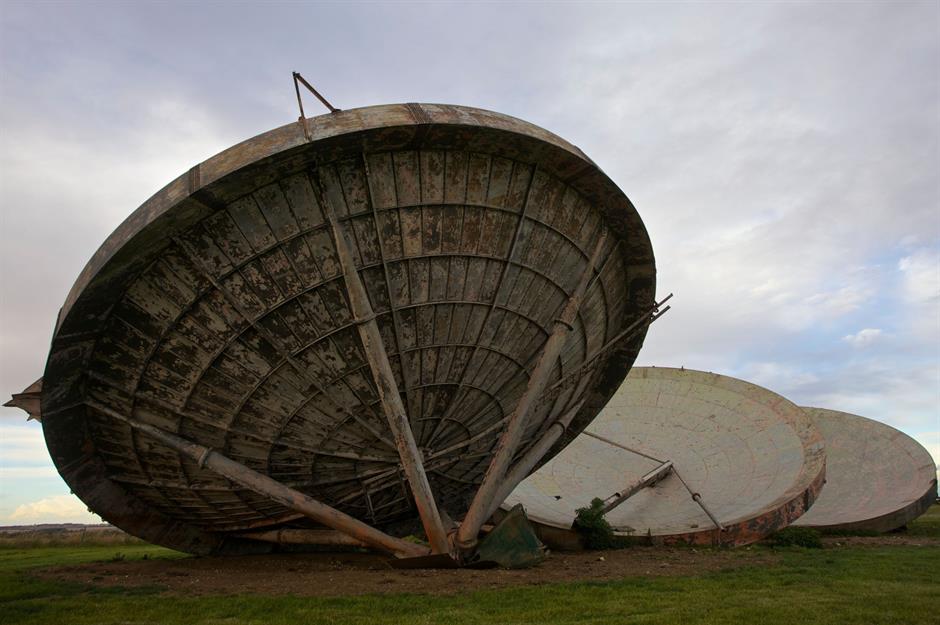
Former Tropospheric Scatter Dishes, RAF Stenigot, Lincolnshire, England, UK
A former radar site in World War II, RAF Stenigot became a communications relay site in 1959 as part of NATO’s ACE High system. Using UHF tropospheric dishes, the 82-station network in nine countries allowed NATO commanders to communicate over long distances.
The network was decommissioned in the late 1980s.
Border Defences, Bucina, Czechia
This Cold War-era border between Germany and the former Czechoslovakia shows what the Iron Curtain looked like.
Barbed wire, electrified fences, a strip of bare earth covering mines, and a line of pyramid-shaped concrete anti-tank traps are all illuminated and overseen by a tall watchtower.
Liking this? Click the Like button above. And click the Follow button above for more great stories from loveEXPLORING
Former Listening Station, Teufelsberg, Germany
The Cold War was a bitter struggle between the West and East for information on what the other side was planning.
With such a small window of warning for any nuclear strike, both NATO and the Warsaw Pact spent much time and effort on advanced technology that might give them an advantage should war break out.
Pagodas, AWRE, Orford Ness, Suffolk, England, UK
Orford Ness on the east coast of England was used as a military test site for much of the 20th century. The distinctive concrete pagodas were built by the Atomic Weapons Research Establishment (AWRE) for testing in real-world conditions.
The design allowed explosive gases to vent safely, but a larger-than-expected explosion would cause the roof to fall and safely seal the testing pit.
Stanley R. Mickelsen Safeguard Complex, Nekoma, North Dakota, USA
Built to defend the nearby Minuteman ICBM silos – an iconic weapon in the American nuclear arsenal – the complex was the first anti-ballistic site in the US.
The Missile Site Radar (the pyramid structure) would guide Spartan (long-range) and Sprint (short-range) missiles to incoming warheads. Viewed as a failure, the complex was closed in 1976 after less than a year.
Alternate Command Post, Long-Range Aviation, Moscow, Russia
Long-Range Aviation was the arm of the Soviet Air Force responsible for long-range nuclear bomber strikes, equivalent to the USAF’s Strategic Air Command.
As Soviet military command structures were likely to be targeted by a NATO nuclear strike, alternative locations like the one shown were constructed to ensure that military operations could continue unhindered.
Find out more
All images are taken with permission from the book Abandoned Cold War Places by Robert Grenville, published by Amber Books Ltd and available via Amazon.
Liked this? Click the Like button above. And click the Follow button above for more great stories from loveEXPLORING
Read on for haunting photos of the world's abandoned sacred spaces