loveEXPLORING EN-UK
Amazing castles and forts with astonishing stories to tell
60 stunning castles around the world
By Ella Buchan · July 16, 2026
If walls could talk
Whether they've faced down bloody wars, revolutions or the whims of Mother Nature, these historic forts and castles from all over the world have survived the centuries to tell a tale.
Click through the gallery for a tour of the planet's most spectacular castles and the magnificent treasures – and secrets – they keep...
Predjama Castle, Slovenia
Dramatic Predjama Castle is tucked within the mouth of a cave in Slovenia, and it's almost difficult to see where the rock ends and the weather-worn fortress begins. This dramatic 13th-century structure, jutting out from a 404-foot-high (123m) cliff, is rumoured to have influenced George R.R. Martin, the author whose novels inspired the hit TV series Game of Thrones.
Predjama Castle, Slovenia
It's hailed as the largest cave castle in the world by Guinness World Records, with a tangle of medieval-style rooms and a complex network of caverns opening out below it. Legend has it, a knight named Erasmus of Lueg took over the castle in the 15th century, and used a series of intricate cave tunnels to steal from the rich and give to the poor, just like Robin Hood. A servant eventually betrayed him, leading to his death.Alcazar of Toledo, Spain
The Alcazar of Toledo, an imposing fortress in central Spain, began life as a Roman Palace in the 3rd century, though it took its current, impressive shape in the 16th century when it was renovated and restored. It was devastated early on in the Spanish Civil War, in 1936, when it was held by triumphant Nationalist forces, and went on to become a symbol of the conflict and of Spanish Nationalism.Alcazar of Toledo, Spain
The Alcazar was painstakingly rebuilt and restored throughout the 1940s and is now the site of the Castilla-La Mancha Regional Library and a military museum. The light-drenched interior courtyard is one of the most beautiful parts of the site.
Chateau De Chambord, France
The Chateau De Chambord in the Loire Valley is a breathtaking example of French Renaissance architecture. Originally built as a hunting lodge for King Francis I, it was completed around 1547 and it's thought that master architect and artist Leonardo Da Vinci played a part in its design. After the French Revolution, some of the furnishings were sold off but, happily, the Chateau itself survived.Chateau De Chambord, France
As grand as the exterior, the chateau’s interior has plenty of stunning details too, and the double staircase is particularly famous and impressive. The swirling 'double helix' (pictured) serves the chateau’s many floors, and is designed so that if one person is ascending and another descending, they needn't run into each other.Hearst Castle, California, USA
This impressive feat was dreamed up by media man William Randolph Hearst, who was inspired by his childhood travels in Europe. He teamed up with architect Julia Morgan in 1919, and the pair would spend almost three decades toiling away on the castle. Poor health meant Hearst never saw it completed, but even in its unfinished state the castle contained some 165 rooms and more than 100 acres of gardens.Hearst Castle, California, USA
Hearst was an art lover, too, and paintings and sculptures practically spill from the property: a highlight is Venus Italica, a sculpture of Venus by Italian Antonio Canova. The castle also has a dreamy Italianate terrace and the glittering Roman pool, with its blue and gold tiles and marble statues.
Mehrangarh Fort, India
Mehrangarh Fort has guarded the northwestern city of Jodhpur since 1459. Built by Rao Jodha, the Rajasthani ruler who founded Jodhpur, the fort is built atop a rugged hill that soars some 400 feet (122m) above the land below.
Liking this? Click on the Follow button above for more great stories from loveEXPLORING
Mehrangarh Fort, India
The fort was embellished and expanded over about five centuries and the result is a sumptuous hodgepodge of architectural styles. Palace rooms burst with coloured glass, mirrors and mosaics too – one of the most beautiful is the opulent Phool Maha or Flower Palace Room.Tower of London, UK
One of the Big Smoke's most famous landmarks, the Tower of London was once a notorious prison. Built from 1078, the tower held well-known inmates, many of whom met a grisly end. These included Anne Boleyn – Henry VIII's second wife who was beheaded in 1536 – and Guy Fawkes, whose plot to overthrow the British monarchy is remembered in the annual firework night on 5 November.Tower of London, UK
The tower's last prisoners were held here surprisingly recently: notorious East End criminals the Kray twins were incarcerated in 1952. As well as being a prison, the Tower has served as an armoury and a menagerie and is now the home of The Crown Jewels. St John's Chapel (pictured) was built for William the Conqueror in the 11th century.Himeji Castle, Japan
One of the finest lasting examples of Japanese castle architecture, Himeji Castle in the Hyogo Prefecture dates to the 14th century. But the castle has been lucky to survive for so long. In 1871, it was put up for auction, after the end of the Han feudal system. The buyer wanted to demolish the castle in order to develop the land, but thankfully changed their mind.Himeji Castle, Japan
The hardy castle miraculously survived the bombings that ravaged Himeji during the Second World War, and also the Great Hanshin earthquake in 1995. Labyrinthine walkways connect different areas of the fortress, and while it looks mighty impressive from the outside, its interiors are sleek and minimalist.Prague Castle, Czechia
Prague Castle is quite the feat. Covering an area of around 750,000 square feet (69,677sqm), the complex is one of the largest of its kind in the world, home to Gothic-style St Vitus Cathedral, as well as several other churches. Dating from the 9th century, the site acts like an architectural textbook for the last millennium and, unsurprisingly, is a UNESCO World Heritage Site.Prague Castle, Czechia
Stunning halls and staterooms fill the castle, brimming with Rococo details, vast fireplaces and priceless paintings. The Rudolph Gallery (pictured) is one of the most striking of them all, with its great arches, chandeliers and mirrors. It was first built in the 16th century, but the stuccos you can see here were only added in the 19th.
Iolani Castle, Hawaii, USA
One of the only real palaces in the USA, Iolani Palace was home to the Hawaiian monarchy in the 19th century. Completed in 1882, it was a sumptuous property ahead of its time, with electricity and modern plumbing. Its architectural style is unique too, dubbed 'American Florentine' for its blend of traditional Hawaiian and Italian Renaissance features – its elegant columns and bold corner towers are particularly striking.Iolani Castle, Hawaii, USA
The interiors are equally as opulent, and the Throne Room is the plushest of them all. Red velvet curtains frame vast windows, chandeliers hang heavily from the ceiling and a pair of gilded thrones sit on a raised platform. Even the sitting room (pictured) is grand. King Kalakaua and Queen Kapi‘olani were the first royals to live here, moving in as soon as their regal abode was completed. The monarchy occupied the palace until 1893 when the then-leader Queen Lili'uokalani was overthrown.Malbork Castle, Poland
The formidable Malbork Castle was built in the 13th century by the Teutonic Knights, a group of German Catholic crusaders, and at the time of its completion was the largest brick castle in the world. Malbork served as a residence for the Polish royal family until it was occupied by the Swedes in the 17th century, then by the Germans during the Second World War.Malbork Castle, Poland
The castle suffered severe damage during the Second World War, but at the end of the conflict, it was returned to Poland. It was then carefully restored and returned to its former glory: today intricate vaulted ceilings, columns and museum displays hide inside its hulking brick exterior.Saladin Citadel, Egypt
The Saladin Citadel is a magnificent medieval Islamic fort in Cairo. Originally constructed in the 12th century, the citadel was the first stage of ruler Saladin's plans to defend the city of Cairo from the Crusaders.Saladin Citadel, Egypt
The Citadel is home to numerous opulent places of worship, including the dazzling Mosque of Muhammed Ali with its decorated cupola and many hanging lights. Construction of the mosque began in the 19th century, and the structure is held up for its sumptuous Ottoman-style design.Bran Castle, Romania
As castles go, Bran is probably one of the spookiest. The medieval fortress in Transylvania became known as 'Dracula’s castle', despite Bram Stoker, author of Dracula, never having visited Romania. Today the castle, with its eerie turrets and stunning hilltop location, remains synonymous with the legendary vampire.
Bran Castle, Romania
The castle is now used to exhibit furniture and artefacts collected by Romania’s late Queen Marie. However, in 2016 two vampire fans became the first people to spend the night in Bran Castle after winning an Airbnb competition. The Canadian siblings slept in velvet-lined coffins and despite some people’s fears, they survived the night.Amer Fort, near Jaipur, India
Perched on a hill, Amer Fort dwarfs the small town of the same name that lies below. Jaipur – around eight miles (13km) away – is known as the 'Pink City' and this fortress, built entirely of red sandstone and marble, is typical of the region's style.Amer Fort, near Jaipur, India
The imposing castle that stands today was started in the 16th century and has been the home of many Rajasthani royals over the years. Inside, the exquisite Sheesh Mahal, or mirror palace (pictured), is one of the highlights and has been immaculately preserved.Edinburgh Castle, Scotland, UK
Edinburgh Castle’s imposing battlements overlook the city’s Old Town. The castle dates back to the 12th century and has been attacked so many times that it has earned the dubious accolade of being 'the most besieged place in Great Britain'.Edinburgh Castle, Scotland, UK
Many royals have called the castle home including King Malcolm III of Scotland and his wife Saint Margaret of Scotland – St. Margaret’s Chapel is a tribute to the late queen and the oldest existing part of the site. Inside, the Great Hall, built for James IV in 1511, is the palace's glorious centrepiece.Castello Di Amorosa, California, USA
Dario Sattui didn’t rush into building Castello di Amorosa in California – he did his groundwork first. Sattui spent years visiting Europe before setting up his winery in Napa Valley, buying and renovating a slew of smaller palatial properties in Italy and then embarking on his master project. The result is a stunning building modelled on a 13th-century Tuscan castle, surrounded by acres of woodland.Castello Di Amorosa, California, USA
To make his dream a reality, Sattui teamed up with builder and medieval-architecture aficionado Fritz Gruber. They employed historic building techniques and even used antique bricks from former Habsburg palaces. The castle was finished by 2007, complete with watchtowers, ramparts, a chapel, a Great Hall and even a torture chamber (just for show, of course).
The Alhambra, Granada, Spain
Granada’s impressive Alhambra was built during Spain’s Moorish period from the mid-13th century. The fortress, perched on a plateau above the city, served as a royal palace, and its exquisite gardens are laced with beautiful walkways and fountains.The Alhambra of Granada, Spain
The Alhambra’s buildings are elaborately decorated from floor to ceiling, and it’s easy to imagine Moorish monarchs wandering through the airy corridors and stunning grounds. Its beauty has inspired many works of literature and film too, including Washington Irving’s Tales of the Alhambra.
Castles of Gondar, Ethiopia
In the 17th century, King Fasilides decided that a little-known Ethiopian town called Gondar would be the new capital of his empire. Over the centuries that followed, the Kings of Ethiopia ruled their subjects from Gondar and several castles were constructed in the town. Incredibly, the castles survived both the First and Second World Wars and remain standing today.Castles of Gondar, Ethiopia
Though it’s now rarely filled with water, this was the swimming pool or public bath in the castle complex of Gondar. Today the bath is used for the Timkat festival, a unique Christian orthodox celebration of Jesus’ baptism. The site also comprises halls, kitchens, steam rooms and even old lion enclosures.De Haar Castle, the Netherlands
The first historical record of the De Haar Castle in Utrecht is from 1391, but the castle that stands today was rebuilt in 1892. Etienne Gustave Frederic Baron van Zuylen van Nyevelt van de Haar (yes, that was his full name) inherited the castle and spent 20 years restoring it with the backing of his wife’s family, the Rothschilds.De Haar Castle, the Netherlands
De Haar’s interior is decorated with richly ornamented woodcarving, mirroring Roman Catholic design at the time, and there are 200 rooms and 30 bathrooms. The castle is situated in beautiful parkland with meticulously landscaped gardens.
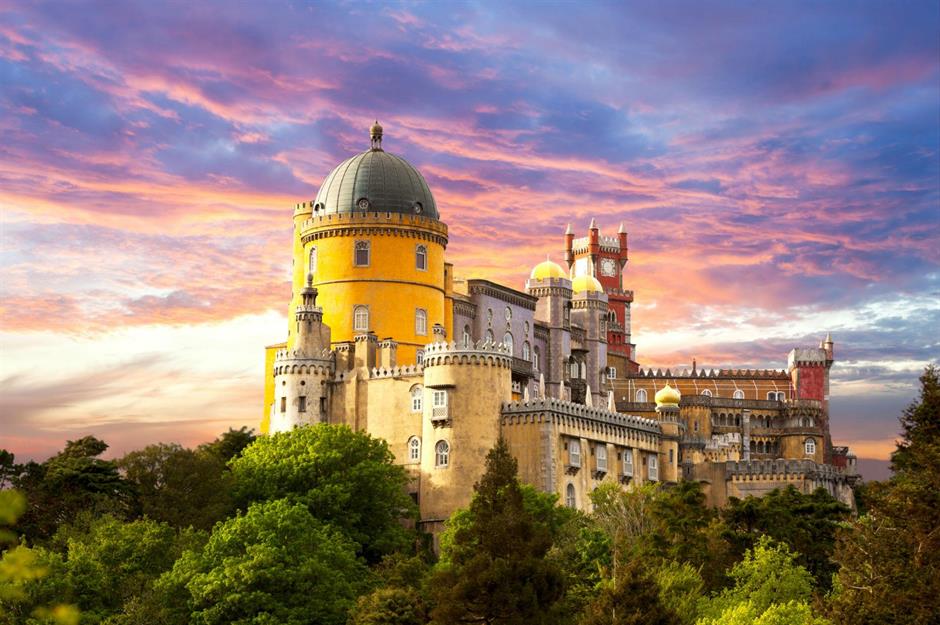
Pena Palace, Portugal
The enchanting Pena Palace, near Sintra, has a storybook quality about it. Designed in a 19th-century Romantic style, it started life as a chapel. King Ferdinand II of Portugal elevated it to its current magnificence after acquiring the property in the 1830s.Pena Palace, Portugal
This photo shows the palace's kitchen and offers a hint of the scale of preparation needed to keep the castle’s royal inhabitants happy. The property is hugged by forested grounds, studded with decorative ornaments and crisscrossed with leafy cobbled walkways.Nizwa Fort, Oman
Oman’s Nizwa Fort, less than two hours southwest of the capital of Muscat, was finished in the 17th century, although the very original structure is from the 12th century. Construction took around 12 years to complete and the design is famous for its architectural deception, involving spiked wooden doors and so-called 'murder holes' used to pour boiling date syrup onto intruders.Nizwa Fort, Oman
With its thick walls, large tower and numerous openings for mortar fire, the Nizwa Fort was certainly built to withstand military attacks. Many of the fort's original details have been retained today too, and the interior comprises a cushion-dotted library (pictured) and rooms filled with exhibits.Peles Castle, Romania
The picturesque Peles Castle was constructed in the 19th century for Romanian King Carol I, who fell in love with the Carpathian Mountains and decided to build a summer retreat here. It's not a modest affair, either: the pile in Sinaia, central Romania is a striking mix of Neo-Renaissance and Gothic Revival architecture.Peles Castle, Romania
There are over 170 rooms, brimming with furniture and intricate details. Some have even been decorated to reflect different cultures, from the Florentine Room to the colourful Turkish Parlor. Pictured here is the magnificent, wood-panelled dining room.Palace of Versailles, France
Famously the one-time residence of Marie Antoinette, the Palace of Versailles (or Chateau De Versailles) near Paris is well renowned for its opulence and extravagance. Constructed in the 17th century, Versailles served as the French royal family’s home until the Revolution, which began in 1789.Palace of Versailles, France
During the Revolution, the palace was stripped of many of its furnishings, but happily lots of the pieces were returned and the chateau has since been restored to its former glory. Though the residence has little shortage of stunning rooms, the glittering Hall of Mirrors (pictured) still somehow manages to outshine the rest.Jaisalmer Fort, India
Jaisalmer fort was constructed in 1156 and, designed to baffle intruders, its yellow sandstone expanse means it's impressively camouflaged. It blends seamlessly with the surrounding Thar desert, especially when the sun sets.Jaisalmer Fort, India
The structure is believed to be one of the only 'living forts' in the world today, as a large population still resides within its walls. Inside there's the Raj Mahal Palace and several Jain temples, as well as the havelis (townhouses) where the local merchants lived. This picture shows an elaborately decorated havelis with ornate doorways typical of the time they were constructed.
Moszna Castle, Poland
Thanks to Moszna Castle's jaw-dropping 365 rooms and 99 turrets, it would be possible to spend every day in a different room over the course of a year if you pleased. Constructed in the 17th century, the castle is situated within a park covered with canals, meadows and forest too.Moszna Castle, Poland
In 1945, Moszna was occupied by the Soviet Red Army leading its owners to flee to Germany. The occupation caused significant damage to Moszna’s interior furnishings, but the castle has since been restored. The opulent site was briefly used as a hospital following the Second World War too, and today it houses an art gallery.Biltmore Estate, North Carolina, USA
When young George Vanderbilt, a New York businessman from a distinguished family, visited the Blue Ridge mountains, he knew he wanted to make them his backyard. And, after six years of construction, Biltmore Estate was finally finished in 1895. Touting itself as 'America’s largest home', it's modelled on a French chateau.Biltmore Estate, North Carolina, USA
Upon its completion, Biltmore Estate boasted an impressive 250 rooms, including 35 bedrooms, which Vanderbilt soon filled with his friends and family. Today it remains a glorious example of the mansions of the Gilded Age, complete with a winery, vast grounds and numerous lodgings.Alcazar of Segovia, Spain
The first historical record of this imposing fort's existence dates to the 12th century, but the majority of the construction was probably completed by King Philip II in the 1500s. Rising high above the city, it's best known for its unusual design: the Alcazar of Segovia is shaped like the bow of a ship.Alcazar of Segovia, Spain
The breathtaking pile has been used as the royal court, a prison and a military college throughout its long life, and today it serves as an artefact-packed museum. The Hall of the Galley (pictured) is in keeping with the ship theme of the Alcazar, since it's designed in the shape of an inverted ship hull.The Citadel of Qaitbay, Egypt
Built in the 15th century, this citadel was designed to protect the kingdom of Alexandria in the country's north. It is believed to have been erected on the same spot as the city's famous Lighthouse, one of the Seven Wonders of the Ancient World.The Citadel of Qaitbay, Egypt
A British invasion in 1882 heavily damaged the fortress leaving it in disrepair for several years. However, in the 20th century, restoration work began, preserving its cavernous, arched passageways for decades to come.Vianden Castle, Luxembourg
Constructed on the site of a Roman castle between the 11th and 14th centuries, this mighty fortress has a string of impressive rooms, including a dinky chapel dating to the 12th century. It has had an extremely diverse set of owners, too, ranging from the Counts of Vianden to a spice merchant.Vianden Castle, Luxembourg
The castle fell into ruin after one owner began selling it off in parts, but it was thankfully restored by the royal family in the 19th century. Members of the Luxembourg resistance even used the castle during a battle against the Nazis in 1944. Highlights today include the gorgeous wood-clad dining room (pictured).Trakai Castle, Lithuania
Lithuania’s Trakai Castle occupies a stunning location in the centre of Lake Galve. The castle was built in the 14th century and is hailed as the only island castle in Eastern Europe. It has served many purposes in its lifetime, going from fortress to residence to a prison. Sadly, in the 17th century, the castle was damaged in conflict and fell into disrepair.Trakai Castle, Lithuania
Happily, the castle was reconstructed after the Second World War and completed in 1961, so it's once again a breathtaking feat of architecture. The inside is as impressive as the outside too: this photo shows the stone walls and artwork of the castle's chapel.
Neuschwanstein Castle, Germany
King Ludwig II of Bavaria built Neuschwanstein Castle in the 19th century to use as a private retreat from public life. Unsurprisingly its dreamy towers and turrets, which could have been plucked straight from a fairy tale, served as inspiration for Disney’s Sleeping Beauty Castle in California.
Neuschwanstein Castle, Germany
Despite its old-world design, it was extremely modern upon its completion, with central heating and even a telephone line. Nevertheless, its interiors show Ludwig's desire to escape into the medieval world that inspired the operas of German composer Richard Wagner, of whom the King was a devoted fan and patron. Much of the art inside depicts the kings, poets and knights that appear in the composer’s work.
Liking this? Click on the Follow button above for more great stories from loveEXPLORING