lovePROPERTY EN-UK
The shocking reality of homes in the world's most expensive city
Peek inside some of the world's smallest and priciest homes
By Kim Easton-Smith · December 27, 2024
Hong Kong living: overcrowded and overpriced
Hong Kong is among the world’s most prosperous cities, but it’s also a tiny coastal area that is struggling to cope with its ever-growing population.
Housing over seven million residents in an area of 427 square miles (1,108sqkm) is a challenge that requires extraordinarily creative solutions, from luxury micro-apartments built into old drain pipes to the tiny coffin and cage homes where you'll find the city’s poorest. Yet, it's consistently named one of the most expensive cities in the world to live in.
Read on to see what the homes are like in this overcrowded and claustrophobic city…
The most expensive city in the world
In the first quarter of 2024, the average price of an apartment in Hong Kong was a staggering HK$13,604 per square foot (US$1.7k/£1.3k) – that's HK$145,572 (US$18.6k/£14.1k) per square metre, according to Hong Kong's Rating and Valuation Department.
Incredibly, that figure has actually gone down in recent years, largely due to Hong Kong's chronic housing shortage and a dip in demand due to its unaffordability. In fact, Hong Kong is one of the least affordable housing markets in the world.
Hong Kong’s property market is sky high
Despite the shortfall, there are still ultra-luxury homes available for the super-rich at the higher end of the market. But because of the sheer number of people living in Hong Kong, even small apartments are unaffordable for ordinary people.
"A skilled service worker requires more than 20 times the average annual income to buy a 645-square-foot (60sqm) flat," according to the UBS Global Real Estate Bubble Index 2023.
Record-breaking prices
In February 2021, a luxury apartment in CK Asset Holdings’ 21 Borrett Road residential project was sold for HK$459 million (US$59m/£45m). Measuring 3,378 square feet, the hefty price tag means each square foot costs HK$136,000 (US$17.4k/£13.2k), setting a new record for the most expensive home per square foot in Asia.
This beat the previous record set in November 2017, when a four-bedroom home in the Mount Nicholson development in The Peak sold for just shy of HK$1.2 billion (US$154m/£116m), working out at just over HK$126,000 (US$16k/£12.2k) per square foot or about HK$1.3 million (US$167k/£125k) per square metre.
An eye-watering view
For renters as well as buyers, the most sought-after – and thus pricey – location in the city is The Peak. The highest point on Hong Kong Island, it comes with cooling maritime breezes and city views. But, for the privilege of soaking up the view, you can expect to spend three or four times the amount you would on rent in London.
Expensive and exclusive
If you've got the money, you can still find spacious homes for sale in this densely populated city. This five-bedroom apartment on the Peak has high ceilings, three and a half bathrooms and 4,440 square feet (412sqm) of space.
Unusually for a Hong Kong apartment, it has three separate outdoor areas – a rooftop retreat, a large terrace and a private backyard. Naturally, this doesn't come cheap. It was listed with Sotheby's for HK$680 million (US$87m/£66m) in 2024.
Little luxuries
Luxury properties are always available for those who can pay, but there's an increased demand for luxury on a smaller scale in Hong Kong.
This narrow flat is in a new property development in the Kowloon district of Hong Kong. The cramped financial hub regularly tops the list of the least affordable housing in the world.
Design solutions
A lack of space is always going to be an issue in Hong Kong, but that doesn't mean a shoebox home can't still feel luxurious.
Property developers are turning to designers to help make these tiny homes more palatable and upmarket for their well-off clientele.
Small spaces that pack a punch
This replica of a nano flat for sale at The Met. Azure on the Hong Kong island of Tsing Yi shows exactly how much you can fit into a small space – in this case, into just 203 square feet (19sqm)!
Prices for flats at The Met. Azure ranges from HK$6.3 million ($808k/£606k) right up to HK$9.4 million ($1.2m/£907k), as of February 2024.
Opulent materials
This micro apartment uses every expert designer trick in the book to make the snug space feel indulgent.
The tiny 228 square foot (21sqm) show flat can be found in the Soyo residential building in Mong Kok, Kowloon. Since coming onto the market in 2022, apartments in the development have sold for up to HK$6.1 million ($783k/£588k).
Liking this? Click on the Follow button above for more great stories from loveMONEY
Packing in the young professionals
Pictured in 2018, finance worker Adrian Law puts away the wall bed in his studio apartment in a new development in the gentrified Sai Ying Pun neighbourhood of Hong Kong, for which he paid around HK$6 million ($770k/£575k) for in 2016.
Nano-flats are the norm, not the exception
Adrian's living situation is far from unusual. As house prices spiral in Hong Kong, young professionals across the city are residing in ever-shrinking spaces, with box-like 'nano-flats' and co-shares touted as fashionable solutions to the affordable housing crisis.
The rise of the tower block
But it's not just the super-wealthy who want to live in the city. There are still plenty of locals too – so how do they cope with the city's staggering housing costs?
High-rise homes are the most common form of accommodation for the average resident, but they can be cramped and overcrowded, and landlords are known to regularly take advantage of the high demand.
Living on top of each other
Even regular apartments are generally very small, particularly in the popular central areas. By way of modest luxury, you can expect a small balcony, but often the view is simply of your neighbours.
For the most part, residents are used to close quarters and small spaces, so they're adaptable when it comes to new housing solutions, though some alternative living arrangements have made headlines...
Hong Kong’s tiny ‘coffin’ apartments
In the past few years, shocking pictures have emerged out of Hong Kong, documenting residents living in what has been dubbed "coffin" homes – subdivided apartments with very little room to move, let alone live.
It’s estimated that more than 200,000 people reside in cramped conditions like this in Hong Kong.
Hong Kong’s tiny ‘coffin’ apartments
The "apartments" are usually bigger units divided up into such small areas that those living in them can’t even stretch out their legs fully. These claustrophobic cubicles tend to cost renters a few hundred dollars a month.
Hong Kong’s tiny ‘coffin’ apartments
The Society for Community Organization (SoCO) worked with photographer Benny Lam on a new project to further highlight the problems faced by those priced out of the rental market in Hong Kong.
From 2012 to 2015, Lam captured shocking images of the living conditions in the city, including in the infamous coffin homes.
Hong Kong’s tiny ‘coffin’ apartments
A 400-square-foot (37sqm) flat can be subdivided to accommodate nearly 20 double-decker-sized sealed bed spaces, sometimes partitioned with wood or even wire. Kitchen and toilet units are usually similar in size and shared by the inhabitants of several cubicles.
Throughout the coronavirus pandemic – during which densely populated Hong Kong reported over 1.8 million cases of COVID-19 and 10,273 deaths as of October 2022 – residents were confined to these tiny, claustrophobic spaces.
Hong Kong’s tiny ‘coffin’ apartments
These squalid and sometimes dangerous conditions make it difficult to understand why the Hong Kong government hasn't done more to tackle the housing crisis.
While some small measures have been taken to increase social housing and control rents, they've done little to solve the problem. More affordable accommodation is still desperately needed.
Hong Kong's cage homes
Hong Kong's property prices have risen to such an extreme that the city's poorest residents are even sleeping in tiny wire cages.
The rampant increase in new luxury development has led to a shrinking supply of older, cheaper blocks, so even these desperately meagre lodgings may soon disappear.
Hong Kong's cage homes
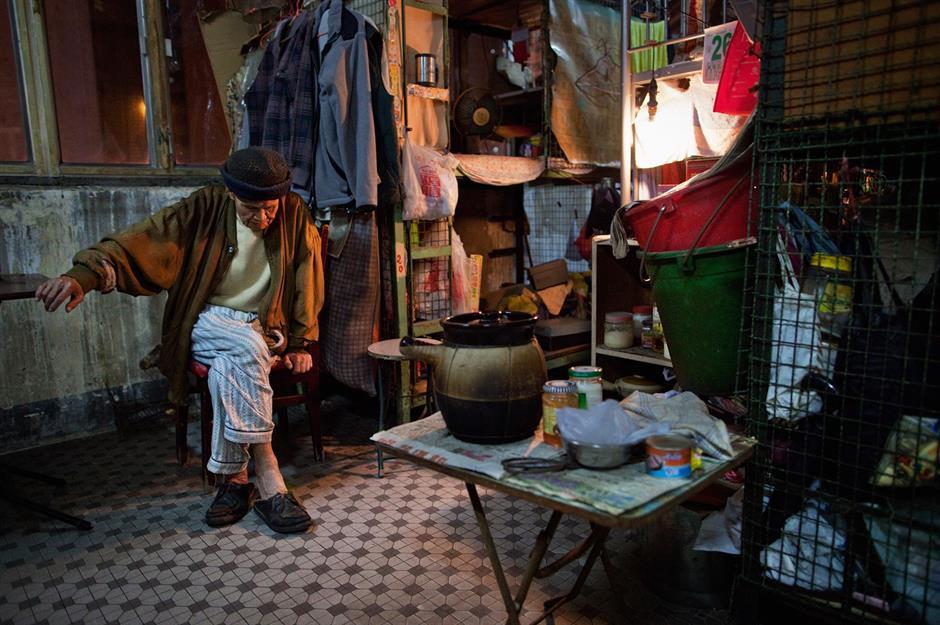
Here an elderly resident sits beside his cage as he prepares to settle in for the evening on the apartment floor that he shares with four others. Thousands of people living in 15-square-foot (1.4sqm) cubicles or cages are being forced to vacate premises, as lots are steadily sold off to developers and low-cost accommodation becomes more difficult to find due to the increasing cost of rent.
The average prison cell in the city measures 75 square feet (7sqm), throwing these grim living conditions into sharp relief.
Hong Kong's cage homes
Another resident relaxes in his bunk bed, which was donated by the Society for Community Organization. Approximately 1,000 or so people are still estimated to live in squalid and cramped conditions in old tenement flats as Hong Kong's staggering wealth gap widens.
This inhospitable situation was exacerbated during the coronavirus pandemic as it was nearly impossible to self-isolate in these suffocating living conditions.
Hong Kong's cage homes
These urban slums are at the most extreme end of the housing crisis in Hong Kong – a far cry from the incredible levels of luxury enjoyed by the wealthy.
The situation has become so serious that students, travellers, entrepreneurs and young business people are opting to co-live to afford to stay in the city.
Campus co-living quarters
Co-living is now becoming standard practice, with finance workers and students alike signing up to new developments in the city, usually sharing with three to four other people.
Campus is a tastefully decorated modern co-living space in Tsuen Wan. Space-saving rooms are shared by four people and beds are integrated into the main rooms, ensuring an open-plan, sociable experience.
Campus co-living quarters
All sleeping spaces come equipped with individual lockable drawers, storage shelves and a hanging rail, as well as individual reading lights, a study desk and a chair. Curtains can be drawn across the bunks for privacy.
Campus co-living quarters
This shared residence is designed with long-term living in mind and is a popular choice with students.
One of its main draws is that it comes with access to a swimming pool and fitness suite, while a shuttle bus allows easy access to Hong Kong's most important locations.
Campus co-living quarters
To build a sense of community, life at Campus revolves around socialising and the management regularly organises group activities such as movie nights and boat trips.
This also appeals to international travellers who sometimes stay in the co-living space for a more authentic experience of life in Hong Kong.
OPod drain pipe houses
The need to find or create affordable living spaces in such an oversubscribed market has led to some truly inventive solutions. The OPod Tube House is an example of micro-housing that makes use of discarded materials, in this case, the city's old drainage.
The brainchild of Hong Kong architect James Law, the Tube House nano-flats are constructed within disused concrete water pipes, offering low-cost starter homes for young local residents. But Law’s plan is more ambitious than simply providing cheap housing for his tenants.
OPod drain pipe houses
Law estimates rent would be around HK$3,000 (US$384/£290) a month for his Tube House nano-flats, however it would be rent with a difference.
"About HK$1,000 (US$128/£96) of that would be the management costs", he told UK newspaper The Guardian in 2018. "The remaining two thousand would be saved on behalf of the young people. It will be invested with interest, and at the end of the tenancy we will return the money to them to help them embark on the next stage of their lives.”
OPod drain pipe houses
Each Tube House unit boasts a bed, a mini-fridge, storage space and a bathroom compartment within its cosy 100 square feet (9.3sqm) of living space.
While Law has planned OPod units for cities across China as well as Vancouver, Canada, it's unclear whether any of these designs have actually come to life. Let's hope this intriguing housing solution isn't just a pipe dream.
Ingenious 'wandering' home
Designer and visual artist Kacey Wong created this intriguing 'wandering' home as a way to question typical ways of living in Hong Kong.
Perched on top of a type of tricycle regularly seen on the streets of Mainland China, the three-foot by four-foot (0.9m x 1.2m) home was originally built by Wong for himself, but he later realised it could potentially offer a solution for Hong Kong's homeless population.
(Very) minimal dwelling
"This project springs from fantasy, imagination and DIY construction", Wong explains on his website. "It explores the idea of minimal dwelling and offers an alternative solution which intrigues us to rethink about our living condition in the city."
He has created numerous other home and travel designs, including 'Paddling Home', which is a comment on mobility and compact living. The four-foot by four-foot (1.2m x 1.2m) house floats on the sea atop barrels and tyres. The floating tiny home includes bay windows, an air conditioning unit and a stainless steel gate and was inspired by Hong Kong's housing crisis.
A large-scale solution
Such a large-scale problem requires a large-scale solution and the Hong Kong government hopes the Lantau Tomorrow Vision will be just that. The project aims to create 4,200 acres (1,700ha) of artificial islands to the east of Lantau Island, pictured here.
When the project – also known as the Kau Yi Chau Artificial Islands – was first announced in 2018, between 260,000 and 400,000 homes were planned to house up to 1.1 million people. Work was scheduled to begin in 2025, however, it is now facing delays of around two to three years according to finance chief Paul Chan.
Estimated to cost around HK$624 billion (US$80bn/£60bn), the grand scheme has been labelled a "white elephant" and has drawn criticism from environmentalists. Only time will tell if it's brought to life – and if it eases Hong Kong's escalating housing crisis...
Liked this? Click on the Follow button above for more great stories from loveMONEY