loveEXPLORING EN-UK
The secret history of Pompeii, from riches to Roman tragedy
The lasting legacy of Pompeii - everything you didn't know
By Katie McGonagle · December 25, 2024
From tragedy to treasure
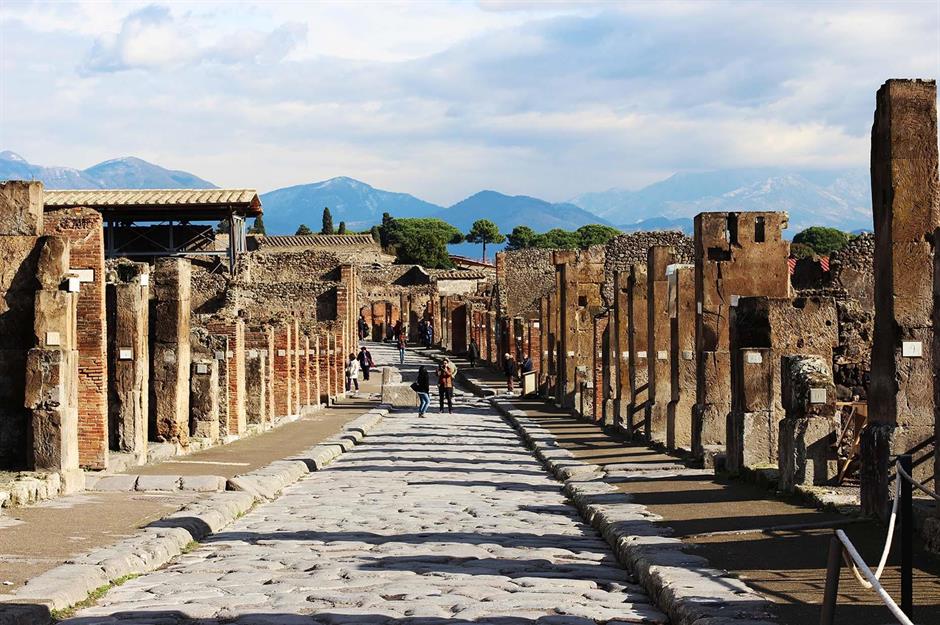
Until the fateful events of AD 79, Pompeii was much like any other Roman resort town. Set on the beautiful Bay of Naples, 14 miles (23km) south of Naples itself, it was home to lavish villas, vineyards and olive groves fed by the rich volcanic soils of Mount Vesuvius – but this active volcano was soon to erupt, burying the town in a thick layer of debris. Ironically, the disaster that proved Pompeii’s undoing also preserved it for years to come. Uncovering this town frozen forever in time helped establish the foundations of modern archaeology.
Read on to discover the fascinating story of Pompeii...
A quirk of geography
Pompeii was one of several towns that sprang up along this sweeping south Italian coastline, drawing on influences from the ancient Greeks and the Etruscan civilisation. They spoke a language called Oscan, until Rome’s influence grew and Latin became the dominant tongue. What those ancient inhabitants didn’t know, however, is the spur of land where the town developed actually formed on a prehistoric lava flow, and there’s evidence of many earlier eruptions from Mount Vesuvius, with similarly devastating consequences.
The Hamptons of ancient Rome
By the time of the first century AD, in the years before the volcanic eruption, Pompeii and nearby Herculaneum had prospered into thriving resort towns as a summer retreat for the Roman elite. Well-to-do Romans built elegant villas filled with mosaics, artworks and elaborate fountains, and its paved streets were filled with shops, taverns, public baths – and a few brothels. The population was well over 10,000, with a mix of wealthy merchants, shopkeepers and slaves.
Gladiators, ready – for a riot
Pompeii’s amphitheatre held up to 20,000 spectators for thrilling gladiatorial battles that drew people from surrounding villages and had the crowd baying for blood. But none more so than in AD 59, when a huge riot broke out between the people of Pompeii and those from nearby Nuceria. What started as name-calling and jeering soon escalated into throwing stones and clashing swords – and a brawl ensued. The senate in Rome investigated and punished Pompeii with a 10-year ban on hosting the games.
The signs were there
The devastating volcanic eruption in AD 79 wasn’t the first time Pompeii had been hit by a natural disaster. An earthquake shook the Campania region in AD 62 (or AD 63 – the exact date is unclear) in what experts now understand was a harbinger of a bigger catastrophe to come. In fact, the people of Pompeii had become so used to tremors rumbling through the town that the increase in seismic activity in the lead-up to the eruption was not treated as a cause for concern.
Vesuvius erupts
On an ordinary day in AD 79 – long believed to be 24 August, although more recent research suggests an autumn date of 24 October – the fate of Pompeii, Herculaneum and the surrounding villages changed forever. Roman author Pliny the Younger, who was across the Bay of Naples in the port town of Misenum at the time, offers the only surviving eyewitness account. He wrote of 'a cloud which appeared of a very unusual size and shape', as Mount Vesuvius exploded in a sky-high plume that is now called a ‘Plinian eruption’.
People flee Pompeii in panic
As people were sitting down to lunch, a light dusting of ash began to drift over Pompeii, followed by heavier downfalls of white pumice stone and debris raining over the town, driven south from the spewing cone of Mount Vesuvius. Some townspeople managed to flee – clinging to as many treasures, jewellery or coins as they could carry with them – while others sought shelter in basements as the roofs of houses began to collapse under the weight of the rocks.The danger continues
Debris continued to pile up at the doors and windows of houses around Pompeii, leaving residents trapped as ash clogged the air and it became impossible to breathe – but an even greater danger lay around the corner. In just a few hours, a fast-moving current of lava, ash and noxious gases known as a ‘pyroclastic flow’ surged from the volcano, engulfing the town and turning it into a boiling-hot inferno. As wave after wave spilled from the fiery summit of Vesuvius, temperatures spiked at more than 300°C (572°F), leaving no one able to survive.
Desperate to escape
Later discoveries would reveal heart-rending tales of people trying – but failing – to escape the deadly lava flow, often with a handful of silver and bronze coins or a clutch of their most valuable treasures to see them on their way. One woman was discovered near the city gates with the gold statue of Mercury, god of speed, in her hands; while another find revealed three horses harnessed and ready to take their owner to safety – except they must have waited too long as they never made it out of town.
Herculaneum was hit too
Pompeii is better-known and draws many more visitors, but its compact neighbour, Herculaneum, is actually closer to the foot of Mount Vesuvius and suffered a similar fate. Here, many people tried to hide or flee to the beaches to seek refuge, but there was no escaping the super-heated surges of ash and lava that poured through the town. It’s a grisly thought, but scientists believe the extraordinary temperatures could have literally boiled their blood and brain tissue, even transforming tissue into glass.
LikING this? Click on the Follow button above for more great stories from loveEXPLORING
A darkness came
A teenage Pliny the Younger watched the events unfold from a seemingly safe distance, but he too was caught up in the panic. At first, he remained in Misenum with his mother, until neighbours pleaded with them to flee and join the crowd of people massing through the streets in search of sanctuary. 'We had scarcely sat down when a darkness came that was not like a moonless or cloudy night, but more like the black of closed and unlighted rooms. You could hear women lamenting, children crying, men shouting,' he wrote later, in a series of letters to Roman historian Tacitus.
One last unending night for the world
Pliny the Younger’s eyewitness account not only tells us much of what we know about Pompeii, but also offers a very relatable insight into chaos and confusion as people scrambled for safety, looking back over their shoulders at the approaching cloud and despairing of their chances for survival. 'There were some so afraid of death that they prayed for death,' he wrote. 'Many raised their hands to the gods, and even more believed that there were no gods any longer, and that this was one last unending night for the world.'
Pliny the Elder to the rescue
While the young 17-year-old stuck by his mother’s side to get her to safety, his uncle Pliny the Elder (pictured, in statue form) dashed into the fray. A noted navy captain and ally of Emperor Vespasian, he sailed a fleet of ships to the small town of Stabiae in an effort to rescue a friend who was stuck there. He made it, but by next morning, falling debris had left him stranded on the beach, where he was overtaken by the fumes – or, if more recent theories are true, was struck down by a stroke or heart attack – and died.
Pompeii's secrets laid bare
The tragic tale of Pompeii slid into obscurity over the years and the bodies lay buried deep below the surface. That is, until the site was discovered quite by accident in the late 16th century, when Swiss architect Domenico Fontana was laying foundations for a building in the Sarno River valley. Even so, it wasn’t until 1709 when another chance discovery revealed the location of Herculaneum that people began to put the pieces together. Within 40 years, the first dig had started to uncover these long-lost secrets – and thus laid the roots for the modern study of archaeology.
Treasures through time
This was no systematic archaeological expedition, but rather a small band of explorers digging up the Campania countryside to see what ancient artefacts they might uncover. It was less for the pursuit of academic inquiry and more to find artworks or other ancient treasures to display. Spanish army general Roque Joaquin de Alcubierre and Swiss architect Karl Weber led the sometimes-haphazard efforts to dig through the layers of rock, soil and sediment that had kept the towns hidden and preserved almost totally intact for many hundreds of years.
Digging for victory
Initial excavations were underwhelming, but in 1755, the ‘praedia’ (estate) of Julia Felix was uncovered, revealing a huge complex of buildings that included apartments for rent, baths open to the public and impressive gardens that featured waterfalls and pools, along with magnificent frescoes depicting everyday life in Pompeii – all owned by a woman, a subject of much scholarly debate since. This was a sign of the finds to come, so King Charles VII of Naples brought in a ban on exporting antiquities – arguably so he could keep them for his royal palace museum at Portici.
Up Pompeii
For many years, the site was only referred to as La Civita as there was no way of being certain about which town or city it was – but that changed thanks to a discovery made in 1763. An inscription was found that read: ‘Rei publicae Pompeianorum’, which meant scholars could at last link the site with the written references to the tragedy of Pompeii – including those from Pliny the Younger. That also halted some of the sloppier methods of excavation and led to a better understanding of the need to preserve this one-of-a-kind site.
Go retro for the Romans
These discoveries were the talk of the town among 18th-century western society and helped fuel a revival of interest in antiquities, coinciding with the rise of the Neoclassical style of architecture and a newfound fascination with all things ancient. Historians have linked this directly to what was being uncovered in Pompeii, as the elaborate villas and frescoes helped drive a design trend for Britain’s wealthy elite to have rooms recreating this classical style, and architects like Robert Adam and Sir John Soane began using these motifs in their work.
Pompeii inspires artists
The eruption of Mount Vesuvius inspired countless artworks recreating the drama of Pompeii’s demise – albeit with varying levels of accuracy – both tapping into and helping to maintain public appetite for this tragic story. They include French artist Pierre-Jacques Volaire and British painter Joseph Wright of Derby, who created more than 30 works on the subject including the one pictured here, titled 'A View of Vesuvius from Posillipo, Naples'.
Becoming a tourist hotspot
This ongoing fascination with Pompeii earned it a spot on the Grand Tour, the rite of passage around Europe often taken by young men of the upper classes in Britain and elsewhere, becoming some of the first tourists to take in these ancient ruins. Unlike the grand edifices of Rome, the ongoing discoveries at Pompeii revealed details of daily life – from the loaves of half-baked bread still in the bakery ovens to the graffiti still scratched on the walls – and it went on to become the world’s first open-air museum.
A young upstart archaeologist
Much of what we know about Pompeii is thanks to the efforts of Italian archaeologist Giuseppe Fiorelli, who took over the site in the 19th century and developed pioneering new techniques. One of the most distinctive symbols of Pompeii is the series of plaster casts that recreate in 3D reality the dying moments of many of the victims. Fiorelli realised there were gaps in the dense crust of rock and ash and deduced this must be where organic matter had rotted away. By pouring in plaster of Paris to the empty spaces, then gently removing the surrounding ash, he brought to life the facial expressions, clothes and final poses of the people of Pompeii in heart-rending detail.
What to see in Pompeii
After decades of excavations, most of Pompeii’s key landmarks have been uncovered – including the grand amphitheatre, one of the oldest surviving examples. It played host to countless gladiator battles over the years, and there are still remnants of paint from the posters that once adorned the walls promoting these events or highlighting certain participants – the celebrities and sports stars of the time. The forum is another must-see. This huge square was once the focal point for public life, where people would go shopping, visit temples dedicated to Apollo, Venus and Jupiter, and catch up on the gossip of the day.
Who lives in a house like this?
As well as public buildings, there are plenty of private homes and villas to visit that reveal even more about the lives of the Roman elite. Highlights include the House of the Small Fountain, which features a pretty mosaic-covered fountain in the garden; and the House of the Faun, named for the bronze statue of a dancing faun in the lobby (a copy of the statue can be seen in the building today, while the original can be found at the National Archaeological Museum of Naples).
Some things never change
One of the strangest things about exploring Pompeii is how many parallels there are between behaviour then and now, proving how little has changed in nearly 2,000 years. At the entrance to the House of the Tragic Poet, a mosaic sign reads ‘cave canem’, or ‘beware of the dog’, which appears in several spots around Pompeii. Many walls were also etched with graffiti boasting of sexual conquests, appealing for the return of stolen goods or the rather more mundane: ‘On 19 April, I made bread’, says one, like a precursor to modern-day social media posts about sourdough…
Pompeii earns UNESCO status
The world had seen the cultural value of Pompeii’s ancient ruins for centuries by the time it was inscribed on the UNESCO World Heritage Site in 1997, along with nearby Pompeii and the ruins of Villa Oplontis in the modern-day town of Torre Annunziata. Not only did that afford an extra level of protection to the precious sites, but it also meant that when torrential flooding hit in 2010 and 2014, experts from the international body were on hand to help with restoration.Recent revelations from Pompeii
More than 275 years since the first dig began at Pompeii, you’d think archaeologists would have found everything they could possibly find here – but in fact, only about two-thirds of the site has been excavated. Recent investigations of previously untouched areas have uncovered a first-century snack-food stall serving chicken and duck with red wine to hungry passers-by. Plus, there’s been political graffiti, a perfectly preserved painting depicting the ancient Greek myth of Leda and the Swan, and a memorably well-endowed rendition of fertility god Priapus – and the revelations keep on coming.
How to visit Pompeii
Pompeii is a treasure trove of ancient history, so every visit is a chance to learn something new. It’s open year-round (shorter hours in winter) and has three entrance gates – Porta Marina near the train station, Piazza Anfiteatro and Piazza Esedra – each with a ticket office. It’s best to go with a licensed guide who can bring to life a pile of rubble by delving into the complex stories behind each point of interest. And don’t forget Herculaneum, which is smaller, easier to get around and less crowded, making a great addition – or alternative – to continue the adventure through the ancient world.
Liked this? Click on the Follow button above for more great stories from loveEXPLORING
Now check out some of the worldwide wonders we've only just discovered