loveEXPLORING UK
Historic Abandoned Places the World Forgot
Abandoned places the world forgot
By Rachel Truman · December 30, 2022
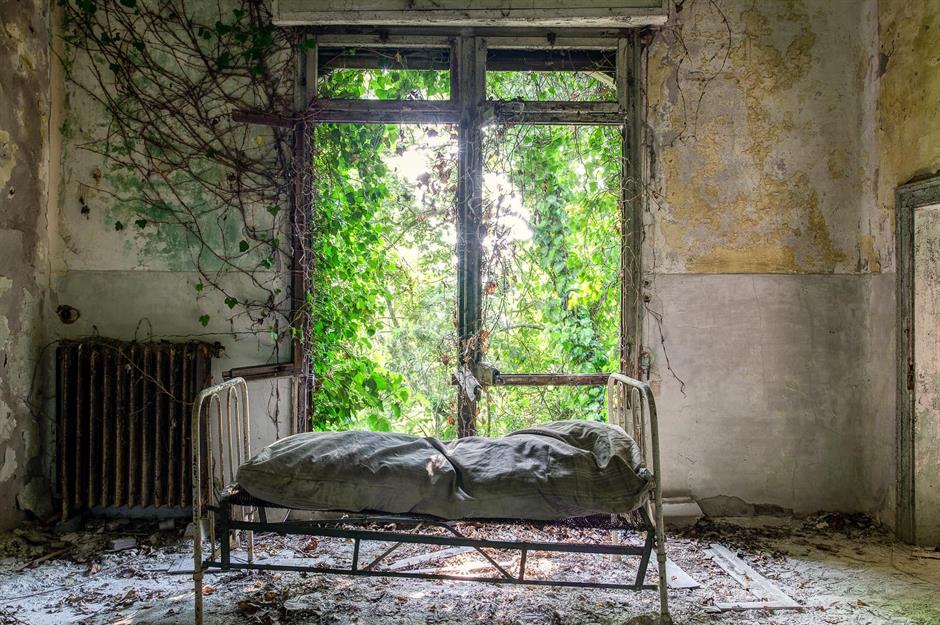
Relics of the past
Faded grand stations devoid of trains, ground-breaking hospitals with long vacant wards, drained swimming pools and uninhabited towns with lingering hints of a human presence. The world is full of abandoned places that once thronged with people, activity and purpose. We take a look at some of the most historic empty places that are a powerful glimpse into an almost forgotten time.Maunsell Sea Forts, UK
The decaying form of these anti-aircraft structures stick ominously out of the water near the mouth of the Thames in southern England. Although an eerie sight, they were put there to protect Britain as part of several navy and army forts constructed during the Second World War to defend the estuary and London from attacks by the Luftwaffe. The forts were decommissioned in the 1950s and abandoned to the elements. Only two of the army forts remain today: the Red Sands and Shivering Sands forts.
Maunsell Sea Forts, UK
They were named collectively after the British civil engineer who designed them, Guy Maunsell. The army forts were made up of seven towers that were connected by steel walkways. They could house nearly 300 soldiers at a time and helped prevent many civilian deaths by successfully shooting down 22 enemy aircraft and 30 V1 flying bombs. The Navy Forts (pictured) had two cylindrical towers with anti-aircraft guns on a connecting platform and housed 120 men, mostly below the waterline. After they were abandoned, parts of the forts were taken over as pirate radio stations in the 1960s and 1970s.
Beelitz-Heilstätten Hospital, Germany
Abandoned a few years after the reunification of Germany, this haunting late 19th-century hospital building has a chequered past. It was originally built in a wooded region southwest of Berlin with extensive gardens as a sanatorium to treat tuberculosis patients with both medical care and fresh country air. Later annexed as a military hospital during the First World War, none other than Adolf Hitler was treated here in 1916 after he sustained injuries in the Battle of the Somme.Beelitz-Heilstätten Hospital, Germany
Beelitz-Heilstätten was once again used as a field hospital when the Second World War broke out to treat Nazi forces. In 1945 it was occupied by Soviet forces and remained their largest military hospital outside the USSR until 1994, when it closed and the complex left to decay. It’s since been used as a haunting set for films including The Pianist and is now a fascinating tourist attraction with guided tours usually available around its crumbling ruins. A canopy pathway and observation tower allow visitors to peer over its overgrown gardens, that include the eerie remains of an old alpine house damaged in the Second World War.
Grange-over-sands Lido, England, UK
A rare Art Deco seawater pool overlooking Morecambe Bay built during the boom of the Lancashire seaside resort in the 1930s lies derelict and fenced off. It's a far cry from the hive of activity it once was. Closed in 1993, the Grange-over-Sands seaside pool is the last remaining lido in the north of England and retains many original features, including its diving platform. Between 1930 and 1939, around 180 open-air pools were constructed in Britain with most towns and cities having at least one.
Grange-over-Sands Lido, England, UK
There is a crowd-funding campaign underfoot to give the dilapidated structure, now a Grade II-listed building, a new lease of life with plans to restore the attraction as a community-owned leisure facility with the large outside swimming pool as its centrepiece. Grants have also been received from the Architectural Heritage Fund and the National Lottery Heritage Fund for the restoration.
Love this? Follow our Facebook page for more travel news and inspiration
Butedale, Canada
Dilapidated remnants of an old fishing cannery town lie strewn along the wooded shores of Princess Royal Island, a remote island in British Columbia. These rare surviving structures are typical of the region's old canneries and give a glimpse into its industrial past as one of the last remaining northern cannery sites in the province. At its peak, over 400 people lived in Butedale, which was first founded in 1911 as a fishing, mining and logging camp. It later became an important salmon cannery, chosen for its proximity to the annual salmon runs in Butedale Passage and coastal shipping routes.
Butedale, Canada
Abandoned in the 1960s, Butedale's empty buildings and rusting industrial machinery are now overgrown with weeds with some slipping into the water. It’s only possible to see the isolated ghost town from the air or water – passengers on cruises and ferries can get a glimpse of the past as they cruise down the Inside Passage on BC's wild north coast. The now uninhabited island, which was also once home to a gold mining camp in the early 20th century, is now the preserve of incredible wildlife, including the white kermode bears which roam around its unspoiled rainforests.
The North Wales Hospital, Wales, UK
Despite being much neglected, vandalised and fire-damaged, the shell of this Victorian hospital in north Wales retains its historic splendour. Opening in 1848 for Welsh-speaking patients with psychiatric illnesses, the Denbigh Insane Asylum, as it was also known, was the first asylum in Wales. It took an innovative approach to treatments, marking a significant historic change to mental health care. By the late 20th century, the asylum had more than 1,500 patients and had expanded over the decades. It was earmarked for closure in the 1960s, but it didn’t shut its doors until 1995.
The North Wales Hospital, Wales, UK
After closing to patients, the local landmark was sold to a private developer but plans fell through and the building fell into further disrepair. Lured by the prospect of exploring a real-life house of horrors, trespassers entered the abandoned asylum which was beset by looting and vandalism including various fires. This continued until the local council sought to gain emergency ownership to protect and enforce the safety of the Grade II-listed building. Now purchased by new owners, the old hospital is scheduled for a major residential redevelopment.
Kolmanskop, Namibia
The sand-strewn, sun-bleached ruins of Kolmanskop in the stark Namib Desert are a curious sight. Briefly home to around 1,000 people at its peak, the town sprung up after a strange stone was discovered in the area by a railway worker in 1908. That stone turned out to be a diamond, and soon rich deposits of the precious mineral were discovered here. As European and Namibian miners, hoping to make their fortune, descended upon the area, the town of Kolmanskop was born.Kolmanskop, Namibia
A wealthy town with lavish houses, a hospital and even a performance hall was built here. However, the diamond deposits were becoming depleted by the 1930s and Kolmanskop's residents heard of rich supplies to the south of town. By 1956 they'd cleared out and the site was left to ruin, slowly to be swallowed by the desert. Located in the Restricted Diamond Area, now known as Tsau Khaeb National Park, it's normally possible to book guided tours of the deserted diamond rush town and its forgotten sand-filled buildings.
Canfranc International Railway Station, Spain
This grand station building is nestled high in the Pyrenees, right on the border with France. It was once one of Europe's most important rail hubs opening in 1928 as a joint Spanish and French venture to great fanfare, with a ceremony attended by Spanish royalty and the French president. The vast and opulent building was abandoned and left to rot and rust in the 1970s, after various political disagreements and a train derailment finally signalled the end of the line.
Canfranc International Railway Station, Spain
During its operation, the mountain station was involved in some key moments in history. It was a portal to freedom for many Jews persecuted by the Nazi regime during the Second World War. However, the Nazis ultimately took hold of Canfranc and it's thought that they also used it to smuggle gold south. The long-defunct station still typically draws in tourists with its dramatic mountainous scenery and rich history. Guided tours are generally available and plans to restore the structure have been set in motion too.
Hashima Island, Japan
Also known as "Battleship Island" because of its distinctive shape, Hashima, off the southwest coast of Japan's Nagasaki Prefecture, was once the site of an important undersea coal mine managed by Mitsubishi. Among the most densely populated places on the planet in its heyday, the island was home to thousands of miners through the 1940s and 1950s. Many of these people were forced labourers brought over from Korea who were subjected to poor conditions and starvation.Hashima Island, Japan
Due to the surge in popularity of petroleum, the coal mine's operations on Hashima closed in the 1970s and its inhabitants abruptly left and were forced to look for work elsewhere. Since then the high-rise apartment blocks, built to accommodate the huge volume of workers, and the mining buildings have been left to moulder. Tours generally go out to visit the eerie "ghost island" with guides chronicling its dark history. Hashima also made an appearance in 2012 James Bond blockbuster Skyfall.
Port Arthur, Australia
First settled as a small timber station in 1830 on the wild southern tip of Tasmania, Port Arthur grew to become one of the British Empire’s largest penal colonies. The site was used to punish transported British convicts who had reoffended and the detainees, including juveniles, were put to back-breaking work such as ship building. By 1853, the era of convict transportation had ended, though Port Arthur wasn't abandoned as a prison until the 1870s. Parts of the neglected site were gutted by fires in the 1890s, and many bricks taken away to build local houses and sheds.
Port Arthur, Australia
Now the macabre ruins, part of the UNESCO Australian Convict Sites World Heritage Property, are one of Tasmania’s most visited places. Around 30 buildings dot the historic site, from its convict-built unconsecrated church and eerie graveyard to the foreboding Penitentiary, first built as a flour mill and granary before housing hundreds of convicts in dormitories and solitary cells. The Separate Prison was where unruly inmates were sent to undergo grim psychological punishments.
Imber Village, England, UK
In December 1943, during the devastation of the Second World War, the residents of Imber Village were given a matter of weeks' notice to evacuate their homes and move on. The little village in the southwestern county of Wiltshire was to be used as an exercise ground for the US army and all residents were forced to leave. The heartbroken villagers did as they were ordered and Imber served its new purpose.Imber Village, England, UK
Although the villagers were assured that they would be able to return eventually, that promise was never kept, and Imber Village still remains a military training ground. The haunting site is off-limits to the public most of the time, however visitors are usually allowed to enter on certain dates each year. During this time, tourists can see its abandoned buildings such as the 13th-century St Giles' church, The Bell Inn pub and a 17th-century manor house known as Imber Court.Ellis Island Immigrant Hospital, New Jersey, USA
One of the most infamous abandoned properties in America, the Ellis Island Immigrant Hospital opened in the early 20th century. The hospital served as a facility to hold, assess and treat immigrants seeking a new life in the United States. If the new arrivals were deemed unfit to enter the US for any reason, they risked being sent back to their home countries.Ellis Island Immigrant Hospital, New Jersey, USA
Numbers coming through the hospital began to dwindle and it eventually closed in 1930. The facility was used to treat military personnel in the decades that followed, but was finally abandoned entirely in the 1950s. After being off-limits to the public for many years, the hospital is now usually open for guided tours through the Save Ellis Island organisation.
Bodie, California, USA
There’s a reason this is the USA’s most famous ghost town. It’s as if time simply stopped in its tracks in Bodie – a deserted settlement in the Sierra Nevada – with its rusted out cars and rickety-looking houses acting as echoes of centuries past. Prospectors struck gold in the mid-1800s and a mill was established. By 1880 Bodie had blossomed into a mining boomtown and den of iniquity with homes for some 10,000 residents as well as 65 saloons, gambling halls, opium dens and brothels. Its heady heyday was short-lived, though.
Bodie, California, USA
The downturn began at the end of the 1800s, when a fire ravaged parts of the town – but Bodie was built back up and wouldn’t be wholly abandoned until the 20th century. By the 1960s, it was declared a State Historic Park and it’s been protected in a state of “arrested decay” ever since. Inside the sunbaked homes, peeling wallpaper, creaking furniture and personal relics offer a glimpse into the lives of Bodie’s former residents.
Kayaköy, Turkey
Hemmed in by the Taurus mountains on Turkey's southwest coast, Kayaköy (formerly known as Levissi) is a Turkish ghost town that has been deserted since the 1920s. The hillside town, whose origins stretch back to at least the 14th century, was once home to tens of thousands of Greek Orthodox Christian and Anatolian Muslim citizens who co-habited happily until the Greco-Turkish war would change the town's fate forever.Kayaköy, Turkey
The conclusion of the Greco-Turkish war saw the Christian residents of Kayaköy forced to leave their homes for Greece. This "population exchange" was meant to ensure that both Turkey and Greece each had just one main religion. Then, in 1957, further devastation occurred when an earthquake struck the town, destroying many homes and public buildings. Kayaköy is now crumbling and deserted, and is usually the domain of tourists and guides retelling the town's heart-wrenching history.Oradour-sur-Glane, France
Abandoned but definitely not forgotten: the weather-worn ruins of this little village in the Limousin region of south-central France have been preserved to stand as a confronting reminder of the atrocities of the Second World War. The rural community was obliterated by SS troops in June 1944 after they stormed into Oradour-sur-Glane, rounded up residents into the church and barns and brutally murdered them. A total of 642 people were killed, many of them women and children.Oradour-sur-Glane, France
While a new village was built nearby, the original Oradour-sur-Glane was preserved as a memorial to the victims of the massacre. Corroding cars still dot the roads and empty buildings have crumbled over time. Visitors typically walk around the town in silence, taking in the church with its bullet-ridden altar and the burnt-out shells of homes and shops. An underground museum offers a glimpse into life in Oradour-sur-Glane before the attacks and adds further context to the atrocities.Poveglia, Italy
Closed off from the world, the little wooded isle of Poveglia in the Venetian Lagoon has a haunting history. It’s also known as Plague Island because in the late 1700s and early 1800s it was used to quarantine plague victims. Numerous islands in the Venetian Lagoon were used for this purpose at this time, and Poveglia reportedly held hundreds of thousands of sufferers. Legend has it that the isle, which was the site of mass burials, is still haunted by the souls of the deceased.Poveglia, Italy
Over the years, the sinister island has served more macabre purposes. Napoleon reportedly used its expanse to store weapons and in the 1920s, a psychiatric hospital opened on Poveglia. Local rumour has it that one evil doctor performed torturous experiments on his patients, even murdering some before throwing himself off the bell tower. Today, the eerie and empty hospital building still stands but the island is off limits to the public.
Here are more intriguing places around the world you aren't allowed to visit
Deception Island, Antarctica
Set near the tip of the Antarctica Peninsula in the South Shetlands, the bleak but beautiful Deception Island harbours the deserted remains of historic settlements. Since the island was first discovered in the early 19th century, it was used as a base by whalers and sealers who set up stations to hunt in its icy marine-life-rich waters. It was also later used as a research base and served as a British military base in the Second Word War. However, the island is an active volcano and three eruptions took place between 1967-1970, destroying the Chilean station at Pendulum Cove and the British station at Whalers Bay. It’s now the preserve of several seabirds species, including a huge colony of chinstrap penguins.
Deception Island, Antarctica
After the eruptions, the bases were abruptly closed and abandoned but humans are once again an occasional presence in this icy wilderness as Deception Island is now a popular stop on Antarctica expeditions. Hikers can see glimpses of the weathered remains of the old whaling station and research bases as they explore the isle’s caldera, black sand beach, jagged rocks and glaciers. The Norwegian whaling station is now designated as a historic site under the Antarctic Treaty. There’s the uncanny remains of a graveyard too where whalers lay buried.