Gallery
These Russians were richer than our royal family. Then it all went wrong.
The rise and fall of the Romanovs
By Danielle McAdam · December 31, 2022
The extraordinary story of the House of Romanov
Once the richest family in the world, the House of Romanov was Russia's ruling dynastic family for over 300 years from 1613 until its deposition in 1917. Each new generation of rulers led to a fresh set of torrid tales, including brutal murders, family betrayals, and assassination plots. Read on to take a trip through the heinous history of the super-rich House of Romanov.The roots of the Romanov dynasty
The House of Romanov first achieved eminence in 1547, when Anastasia Romanovna married Ivan IV Vasilyevich. He was the first Tsar of Russia and a member of the Rurik dynasty, which had ruled in Russia since the 860s. Anastasia was the daughter of a Russian nobleman, Roman Yurievich Zakharyin (pictured), who was the originator of the Romanov name. His descendents would later take the surname to honour Zakharyin; Romanov translates to ‘Son of Roman’.
A bride fit for a Tsar
Anastasia Romanovna (pictured) was chosen as the Tsar's bride from a large pool of candidates, with all of Russia's noble families invited to the Kremlin to present their daughters as potential matches. It's estimated that there was anywhere between 500 and 1,500 women in attendance. Romanova and Vasilyevich married in February 1547. As the first Russian tsarina, Anastasia was known to have a positive effect on the ruthless ruler's infamous ill temper, which was so extreme that he would earn the nickname Ivan The Terrible. The couple had six children together: Anna, Maria, Dmitry, Ivan, Eudoxia, and Feodor.
The wrath of Ivan the Terrible
Tragedy struck when Anastasia fell ill and died suddenly in 1560. Deeply fond of his wife, Ivan the Terrible (pictured) suffered a breakdown and his infamous fury worsened. He suspected Anastasia had been poisoned by boyars, noblemen with high military standing, who also served as advisers to the Tsar. As a result, he had many of them tortured or executed. Ivan's suspicions are likely to have been legitimate. Archeologists and forensic experts analysed Anastasia's bones in the late 20th century, and found that her hair contained significant quantities of mercury. While mercury was used as a medicine in the 16th century, the high levels suggest that poisoning is the most likely explanation.
Miscarriage and murder
Ivan's violent wrath extended to his family. In 1581, he severely beat his pregnant daughter-in-law Yelena Sheremeteva for wearing what he deemed to be inappropriate clothing. This reportedly caused her to miscarry. As a result, his second son, also named Ivan, had a heated argument with his father. Ivan the Terrible hit his son over the head with a weapon, fatally wounding him.
Pictured: Ivan the Terrible murders his son, as imagined by the 19th-century artist lya Repin.
Checkmate: death over a game of chess
The Tsar's reign of terror ended with his death in 1584, when he suffered a stroke while playing chess. His middle son Feodor ascended to the throne and was crowned Feodor I. He was widely considered to be a poor leader with limited political abilities.
Pictured: The death of Ivan the Terrible.
The Time of Troubles
Feodor (pictured) died childless in 1598, bringing the Rurik Dynasty's 700-year reign to an end. This sparked a succession crisis in Russia, ushering in 15 years that became known as the 'Time of Troubles'. During this period, the country devolved into anarchy and political unrest, with numerous usurpers claiming the title of Tsar.
This included several 'false Dmitrys' – imposters claiming to be the youngest son of Ivan the Terrible, who was assassinated at the age of eight in 1591. Each said they had escaped and been in hiding. There were four false Dmitrys during this period, although some argue that there was actually only three, with the fourth a mistake due to bad record-keeping.
The boy who would be king
In February 1613, the Zemsky Sobor, a parliament representing Russia's feudal classes, elected Michael Romanov (pictured) as the new Tsar of Russia. His accession to the throne finally brought an end to the period of upheaval. Michael was connected to the Rurik dynasty: the 16-year-old boy's grandfather Nikita Romanovich had been an adviser to Ivan the Terrible, while Nikita's sister (and Michael's great aunt) was Anastasia Romanovna. This established the House of Romanov as Russia’s second ruling dynasty.
The popularity of Peter the Great
Peter I (pictured), Michael's grandson, founded the Russian Empire in 1721, declaring himself as Emperor and transforming the country into an impressive power through a series of wars and reforms, and replacing old social and political structures with modern alternatives. These changes, which earned him the moniker Peter the Great, had a long-lasting impact on Russia, with many aspects of the current Russian government traced back to his reign.
The grand Peterhof Palace
The Peterhof Palace (pictured), a grand collection of palaces and gardens, was commissioned by Peter the Great. Initially meant as a country dwelling and constructed in 1709, Peter the Great decided to extend the property upon visiting the French royal court in 1717, earning it the moniker 'The Russian Versailles'. The construction was mostly complete by the time of the ruler's death from a gangrenous infection in his bladder in 1725, though his daughter Elizabeth of Russia continued to expand the lavish abode following the death of her father.
Introducing new traditions
Before his death, Peter the Great revised the male heir succession tradition, enabling him to choose an heir. His son Tsarevich Alexei was opposed to Russia's modernisation. As a result, the Emperor selected his second wife, Empress Catherine, to take the throne. She ruled until she died in 1727. This established a new tradition whereby Emperors or Empresses could select a successor before their death.
Pictured: the Peter the Great Monument in St Petersburg.
The House of Holstein-Gottorp
Fast-forward to 1762, when the death of Empress Elizabeth of Russia brought an abrupt end to the Romanov family's direct male line. As a result, the House of Holstein-Gottorp, a matrilineal (female line) descendent of the Romanov bloodline, succeeded to the throne in the form of Peter III. Descendents of this line are sometimes referred to as 'Holstein-Gottorp-Romanov'. Due to their blood ties with the Romanov dynasty, they retained the surname to strengthen their position of power in the country.
Pictured: the Romanov emblem.
A wife's betrayal
Peter III's reign was fleeting, lasting a mere six months. German-born, he barely spoke Russian and was universally disliked. Soldiers loyal to his wife Catherine II captured him, and he was forced to abdicate. Despite her German origins, Catherine was a Russian nationalist who was loved by the people. Catherine succeeded Peter and became Empress in July 1762. Peter III died in prison in the same month. Despite his short rule, he paved the way for progressive policies, which included religious freedom, supporting education, and the modernisation of the Russian army.
The reign of Catherine the Great
Catherine II gained the title Catherine the Great during her reign. Under her leadership, the Russian Empire became larger and stronger, becoming an established European superpower. As a supporter of the work of Peter the Great, she continued to modernise Russia. Catherine's reign was known as the Russian Empire's 'Golden Age'. However, there were still rebellions, as the military and economy relied heavily on serfdom.
Abolition and upset
Following Catherine the Great's death in 1796, her son Paul I (pictured) became Emperor. He administered reforms that granted peasants and serfs more rights, upsetting the noble classes in the process. In another unpopular move, he abolished Peter the Great's lineage law, which had previously allowed each reigning Emperor or Empress to pick his or her successor. Instead, he put in place a strict order of succession, which saw the eldest son of each monarch inherit the throne. This prompted his adversaries to plot his demise...
The shocking murder of Paul I
In March 1801, a band of dismissed military nobles, spurred on by alcohol, charged into Paul I’s bed chamber at St Michael's Castle, where they found the terrified Emperor cowering in fear behind the curtains. The rebels tried to force his abdication but he refused so they stabbed him with a sword before brutally strangling and trampling him to death.
A son's betrayal
Paul's successor, his 23-year-old son Alexander (pictured), was present in the palace during the assassination. While he had given his consent for the deposal of his father, he had not expected him to be murdered. Regardless, he did not bring those responsible for his father's death to justice. Alexander was Emperor of Russia from 1801 until his death in 1825. Ruling during the times of the Napoleonic Wars, he gained terrority in Poland and Finland as part of the winning coalition against Napoleon. This made him the first King of 'Congress Poland', as it was known, from 1815, as well as the Grand Duke of Finland from 1809 until his death.
The Decembrist Revolt
As Alexander had no living children, his brother Constantine was the natural successor. He was Emperor for just 25 days, however, before declining the responsibility; his younger brother Nicholas then claimed the throne. On hearing the news about Nicholas, a band of 3,000 men attempted to stage a military coup in Constantine's favour, assembling in Saint Petersburg on 26 December 1825. However, the coup failed, and many involved were executed as a result. This became known as the Decembrist Revolt (depicted in this picture). Nicholas I went on to serve as Emperor of Russia, King of Poland, and Grand Duke of Finland from 1825 until his death in 1855.
The assassination of Nicholas II
Nicholas I was succeeded by his son Alexander II (pictured), whose reign began in the midst of the Crimean War (1853-1856). Despite being a strong and popular ruler, Alexander's personal life was problematic. His sickly wife Maria spent most of her time overseas, so he took a mistress, Princess Catherine Dolgorukova. Following his wife's death, Alexander married Dolgorukova, thereby legitimising their three children. Rumours that Alexander II intended to crown his new wife as Empress created unrest, with high-ranking women, in particular, scandalised by the prospect of having to serve a woman who had carried the Emperor's children during his first wife's lifetime. However, before she could be crowned, Nicholas was assassinated in March 1881. He was killed by a bomb, with the plot executed by social revolutionaries who hoped to overthrow the Tsarist autocracy in Russia.
Alexander The Peacemaker
Alexander II was succeeded by his son, Alexander III, the second-to-last Romanov, who came to the throne in March 1881. Fearing he could meet the same fate as his father, Alexander strengthened autocratic rule in Russia. In addition, he reversed several of his father's more liberal initiatives, adopting a more conservative approach to leadership. Russia had no major conflicts during his reign, earning him the moniker The Peacemaker.
Imperial Eggs
It was Alexander III who started the Romanov tradition of gifting and collecting luxurious Fabergé eggs. The opulent jewelled eggs, also known as Imperial Eggs, were created by the House of Fabergé in Saint Petersburg for the ruling family. In 1885, Alexander commissioned one as an Easter present for his wife, Empress Maria Feodornva. The Hen Egg (pictured) was made of gold and coated with an enamel shell to resemble a real egg. It opened to reveal a golden 'yolk' which contained a golden hen within. Inside the hen was a mini replica of the imperial crown and a ruby pendant. Between 1885 and 1916, 50 eggs were created for the Romanov family, becoming more expensive and extravagant as the years went on.
The last Romanov ruler
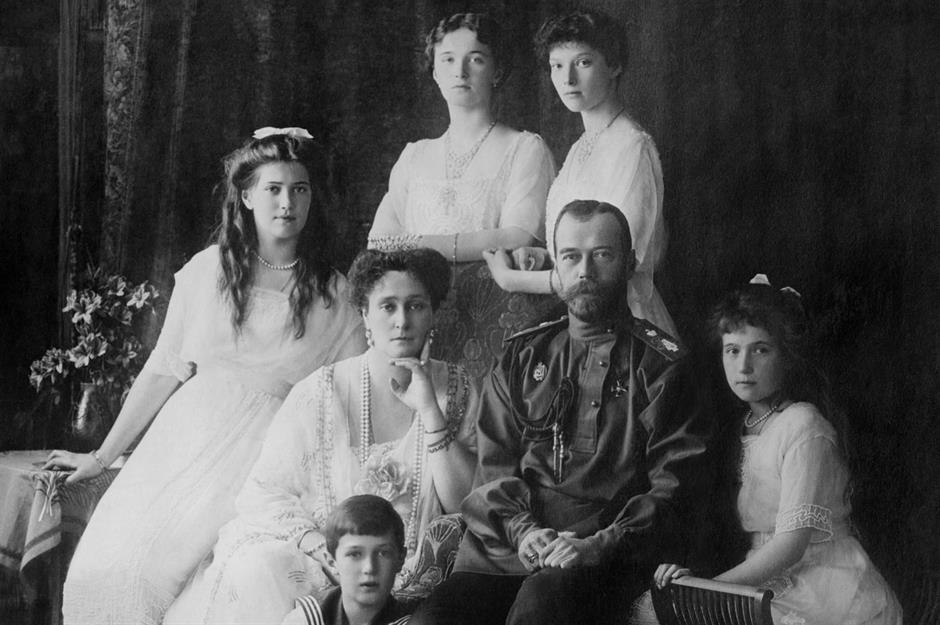
Alexander III was diagnosed with terminal kidney disease in 1894 and died in October that year. He was succeeded by his eldest son Nicholas, who became Nicholas II. Shortly after his father's funeral, Nicholas married Princess Alix of Hesse and by Rhine, a granddaughter of England's Queen Victoria. Although Nicholas was said to be a kind man, he upheld his father's severe policies. Nicholas and Alix had five children together: Olga, Tatiana, Maria, Anastasia, and Alexei (pictured).
Alix of Hesse-Darmstadt
Nicholas's wife Alix assumed the name Alexandra Feodorovna after becoming a devout convert of the Russian Orthodox Church. Timid and serious by nature, she avoided many of the social obligations traditionally assigned to Russia's tsarinas, which included hosting balls and other society parties, and reportedly had a dislike of Russian culture. As a result, the people of Russia disliked her.
Royal traditions
Nicholas II upheld the Easter tradition of gifting Fabergé eggs. The most famous egg is The Imperial Coronation, created in 1897 for Empress Alexandra Fyodorovna. Made from gold, it had a lime yellow enamel coating and a starburst pattern that reflected the robes worn by Empress Alexandra Fyodorovna at her coronation. Inside the velvet-lined egg was a replica of the 18th-century Imperial coach that transported Alexandra to her coronation. These lavish gifts weren't the new Tsar's only display of wealth...
The richest family in the world
By the time Nicholas II ascended to the throne, he had an eye-watering fortune of around $300 billion (£222.9bn) in today's money, making the Romanov ruling dynasty the wealthiest family in the world at the time. Despite Russia being impoverished, war-torn, and politically strained, his family enjoyed the finer things in life. Alexandra and her daughter's clothes were made by French designers, with their shoes and hats hailing from London. Furthermore, the family owned a 401-foot superyacht, The Standart, described as a "floating palace." It boasted mahogany-panelled rooms, crystal chandeliers, and even a chapel.
Pictured: A cabin inside The Standart.
A plethora of palaces
The Romanov rulers also had their pick of royal residences to live in. In addition to the previously mentioned Peterhof Palace, the magnificent Winter Palace in Saint Peterburg was built and altered continuously between the 1730s and 1837, after a fire damaged Peter the Great's original design. The Hermitage Museum is now housed in the majestic three-story abode, which has 1,786 doors, 1,945 windows, and 1,057 rooms. Nicholas II, however, preferred the privacy and seclusion of the Alexander Palace, located south of Saint Peterburg. The grand building, which overlooks beautiful gardens, was commissioned during the reign of Catherine the Great.
Pictured: the jaw-dropping interior of the Winter Palace.
The influence of Rasputin
It wasn't only the wealth of the Romanovs that angered the Russian people. Empress Alexandra Feodorovna's relationship with Grigori Rasputin (pictured), a Russian mystic and self-proclaimed holy man, also contributed to their unpopularity. Rasputin's stronghold on the Romanov family enraged nobles, religious leaders, and peasants alike, with many considering him a fraud. On 30 December 1916, Russian aristocrats assassinated Rasputin in a bid to bring an end to his influence.
Alix was a carrier of the haemophilia gene, which was prevalent among the descendents of Queen Victoria. Nicholas and Alix's son Alexei inherited the disease and suffered from periods of illness. Alix was loyal to and influenced by Rasputin for years, believing he could cure her son's sickness. Nicholas II was dedicated to his wife and her beliefs, which in turn hurt his reputation as a ruler.
The downfall of Nicholas II
In 1915, Nicholas II departed Saint Petersburg to take command of the crumbling Russian Army in World War I (pictured), staying on the front until 1916. By 1917, however, most Russians had lost confidence in his leadership. With the Russian economy gravely hurt by the war, many wanted Nicholas II removed.
The abdication of Nicholas II
In 1917, satirical cartoons frequently mocked the Romanovs, portraying them as wealthy tyrants living in luxury while their subjects suffered and starved. The satirical poster pictured was published by the leftist publishing house Parus, created before the revolution by writer Maxim Gorky. The top illustration depicts a soldier defending the rich and ruling social classes and reads, "This is who the soldier used to defend." The second, post-revolutionary image shows banners with the words "Land and freedom!" "Democracy and the Republic!" and "Liberty!", with the caption reading, "That's who he defends today." As a result of his growing unpopularity, Nicholas II was forced to abdicate on 15 March 1917.
The end of the Romanov reign
The abdication of Nicholas brought an end to the Romanov reign, which had lasted over 300 years. During the October Revolution, which took place on 7 November 1917 and was led by Vladimir Lenin and the Bolshevik Party, radical socialists seized power. They established Russia's first communist government, as well as the first large-scale socialist state in global history. Nicholas II and his family, meanwhile, were placed under house arrest in Sibera before being transferred to Ipatiev House, a merchant's house located in Yekaterinburg.
A horrific fate
On 16 July 1918, Nicholas, Alix, and their children were told to get dressed and go to the basement of the house. They were then shot by a firing squad before being brutally beaten to death by communist soldiers. Just like the wealth of the Romanovs was in part responsible for their demise, their riches also robbed them of a swift end. Diamonds and other precious gemstones were sewn into the undergarments of the young Romanov princesses. Bullets ricocheted off the diamonds, causing the soldiers to mercilessly beat them to death.
In 1991, the bones of Nicholas II, his wife, and three of their daughters were recovered in a mass grave in the Ural Mountains. The remains of Alexei and the fourth sister remained undiscovered until 2007 when a second burial site near the original location was discovered. DNA testing suggested the bones belonged to the missing Romanov children.
Pictured: Tomb of Nicholas II and his family.
Seizure of the Romanov fortune
Following the violent assassination of the Romanov family, the Bolshevik government seized assets such as palaces, art, and jewels. Other valuables, like the gold reserves, evaporated within a few years, owing largely to communist economic incompetence. Other Romanov treasures and gems simply vanished without a trace; it's believed that the extended Romanov family escaped the revolution and smuggled these items out of the country. Revolutionaries were also caught trying to steal some of the lucrative artefacts for their own personal benefit. Much finery seized by the Bolshevik government, such as a gold kolchan of Tsar Mikhail Romanov and the diamond crown of Tsar Ivan Alexelvich (pictured), is now displayed at the Kremlin.
The Romanov imposters
Prior to the discovery of the remains, several imposters claimed to be the Romanov children over the years, primarily Alexei and Anastasia. The most convincing imposter was Anna Anderson (pictured), who claimed to be the Grand Duchess Anastasia, Nicholas II's youngest daughter. Many people were convinced by her story, largely due to her resemblance to the dead princess. However, a 1927 investigation funded by Alix's brother Ernest Louis, Grand Duke of Hesse, uncovered the truth. Anderson was actually Franziska Schanzkowska, a Polish factory worker with a history of mental illness.
The modern-day Romanovs
Although the Romanov name will never be synonymous with an active reigning dynasty again, their bloodline lives on. Prince Andrew Romanoff, Nicholas II's grand-nephew, is one notable descendent. His father, Prince Andrei Alexandrovich, fled Russia in 1918 to escape the revolution. Prince Andrew was born in London in 1923 and grew up in the grounds of Windsor Castle. He later moved to America and became an artist. Prince Andrew's half-sister Princess Olga Andreevna (pictured), meanwhile, is president of the Romanov Family Association. The organisation was launched in 1979 to bring together descendents of Emperor Nicholas I.
Now read about the world's richest royal families